

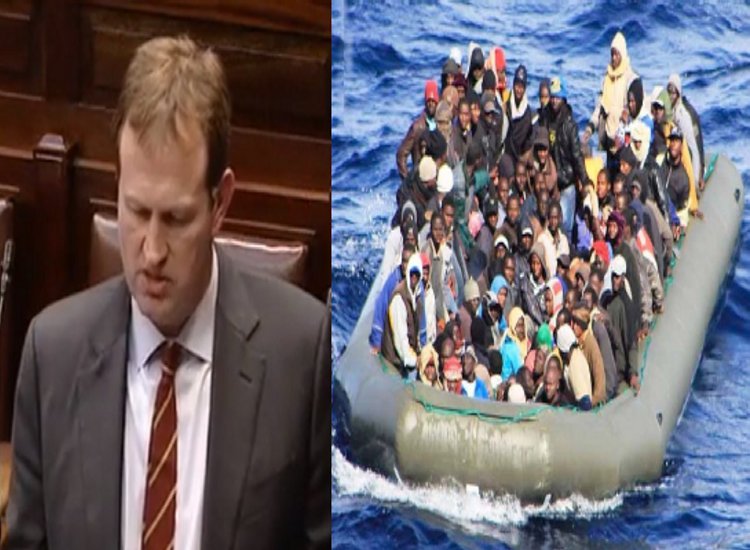
The Minister for Justice has stated that he aims to reduce the number of asylum seekers entering Ireland to below 10,000 annually, reports Breaking News.
Jim O’Callaghan said the current level of asylum applications is “too high,” noting that over 18,500 individuals sought asylum in Ireland during 2024.
In the years prior to the pandemic, Ireland typically received between 3,000 and 5,000 international protection applications annually, reports Breaking News.
That figure dropped to between 1,500 and 2,600 in 2020 and 2021 before surging to more than 13,500 in both 2022 and 2023.
Simultaneously, over 114,000 people arrived in Ireland fleeing the conflict in Ukraine.
This brought the total number of individuals seeking temporary or international protection to 159,000 during the three-year period from 2022 to 2024, reports Breaking News.
Mr O’Callaghan said these figures “created a crisis,” telling the Justice Committee on Tuesday: “They threatened to overwhelm the ability of the International Protection Office to process cases and placed the State in a very weak negotiating position, as it needed to dramatically expand the accommodation available to both international protection applicants and Ukrainian citizens.”
His predecessor, Roderic O’Gorman, had projected that 15,000 annual applicants could become the “new normal”, reports Breaking News.
However, Mr O’Callaghan said: “I still think those numbers are too high,” reports Breaking News.
TheLiberal.ie won’t quit
Please support us with a small donation on PayPal!

He expressed a desire to reduce the “eye-watering” expenditure on the International Protection Accommodation Service.
Just over €1 billion was spent in 2024 on housing international protection applicants, with €1.2 billion earmarked for 2025.
The minister explained that the primary factor driving costs was the volume of arrivals who required accommodation, reports Breaking News.
“And I think what we have seen in the years where there was a surge, 2022-2024, may have been a consequence from what was happening as a result of the Covid years where people didn’t come through. But I certainly want to see numbers under 10,000. It’s difficult for that to be controlled, but in terms of measures that I introduce, I think that is an effective way of trying to do it,” reports Breaking News.
He continued: “The reason we spent one billion last year is because 33,000 people or so are being accommodated. So that’s the real driver of it. And the way to respond to that is to get people through the system much faster, to have their applications processed so they’re not staying in an IPAS centre for one to three years. You want to get them in and out promptly over a period of months,” reports Breaking News.
Mr O’Callaghan noted that the average nightly cost of accommodating an applicant was €84 in 2024, though that figure has since fallen to €71.
He said he was hesitant to publicise this information because he did not want future contracts to assume a €71 baseline, as his goal is to reduce the cost even further, reports Breaking News.
Additionally, he shared that he had experienced a “doorstep” identity check after disembarking a flight.
He added that 4,154 such flight checks were conducted between January and the end of August.
“They are effective in trying to respond to people arriving here without identification. It’s a lot – like it was doorstepped step myself recently coming off a flight,” reports Breaking News.
Tell us your thoughts in the Facebook post and share this with your friends.

