

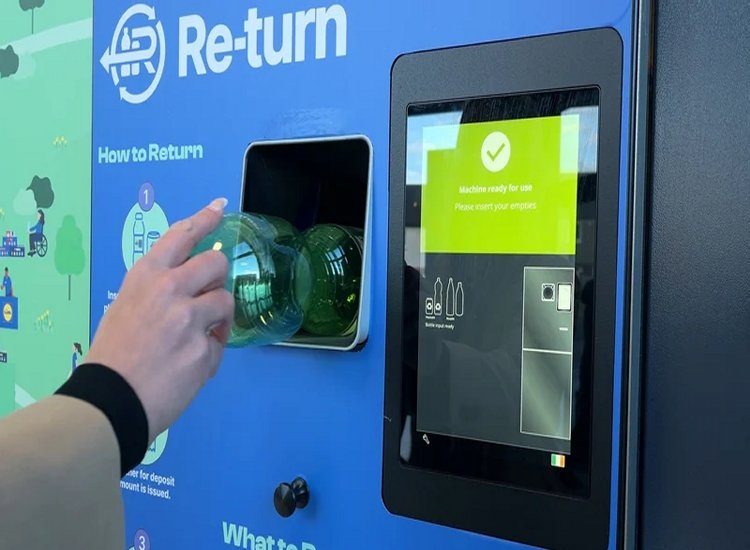
Irish shoppers left €66.7 million unclaimed last year by not redeeming their deposits on drink containers under the Government’s Deposit Return Scheme (DRS), reports RTE.
That’s according to Re-Turn’s 2024 annual report, which reveals that the large amount of unclaimed deposits was the main reason the State-backed organisation reported a pre-tax surplus of €51.3 million for the year.
Re-Turn, which was set up by the Government, officially launched its DRS operations on 1 February 2024 with the goal of greatly improving the recycling rate of cans and bottles, reports RTE.
In 2024, a total of 877.85 million containers were returned, including 433.2 million plastic bottles and 444.6 million cans.
The annual report shows that Re-Turn earned €114.4 million in revenue during the year, reports RTE.
This included €66.7 million in unclaimed deposits and €47.7 million from other sources, such as €17.2 million from selling recyclable materials and €30.5 million from fees paid by producers.
The report also discloses that the unclaimed deposits led to Re-Turn paying a €23.7 million VAT settlement.
Re-Turn’s total expenditure in 2024 came to €62.2 million, which included €46.5 million in direct costs related to collecting and recycling, and €15.7 million in administrative expenses. These admin costs included €4.6 million spent on ‘marketing, communications, and public awareness’, reports RTE.
According to the report, the €66.7 million figure reflects the amount of unredeemed deposits during the financial year and “this is after a €36.5m estimate of deposits expected to be returned post year end”.
It states that “unredeemed deposits are an expected and routine scenario for deposit return schemes and it was anticipated that in the initial transition period redemptions would be low and therefore there would be a high level of unredeemed deposits”, reports RTE.

The report explains that, as a non-profit entity, the early-stage surplus from unclaimed deposits is being used in multiple ways.
These include covering the scheme’s initial launch expenses, building infrastructure, promoting public education, and contributing to a legally required reserve fund, reports RTE.
The report goes on to say that unclaimed deposit income “is expected to significantly reduce as the scheme reaches its targeted redemptions of 90% in the coming years”.
It adds that “in the long term, should unredeemed deposits be higher than forecast, we would support initiatives that drive increased adoption of the scheme as well as investing in broader innovative projects designed to further the country’s circular economy strategy”, reports RTE.
Re-Turn ended the year with €89.8 million in cash, the report states.
However, this figure is expected to fall significantly in 2025 due to several major outlays. Once these are considered, the adjusted cash balance would drop to around €32 million.
Planned expenditures include the €23.7 million VAT settlement, a €13.8 million contribution to the contingency reserve, €11.7 million to repay a loan from Bank of Ireland, a grant of approximately €3.2 million to retailers for 2024, and €5.4 million set aside for corporation tax linked to the scheme’s surplus, reports RTE.
In a statement included with the report, Re-Turn CEO Ciaran Foley said: “Thanks to the incredible buy-in and adoption from the Irish public, 877 million containers were returned through DRS in 2024, equating to an average 66% post transition period recycling rate. The seasonality of the soft drinks market was reflected in some even higher months, such as in August when the return rate reached 75%. Every 1% increase equates to around 19 million containers, and we recorded some daily returns of over 5 million products over the Christmas period,” reports RTE.
Tony Keohane, Chair of Re-Turn, said the February 2024 launch of Ireland’s DRS marked a major step forward in the country’s path to a greener future.
He said: “From a standing start in Autumn 2022, the scheme collected more than 877 million drinks containers in its first 11 months. In that short time, we’ve seen Irish consumers recycle more bottles and cans than ever before and do so in a way that produces high quality recyclate, helping build a truly circular economy,” reports RTE.
Tell us your thoughts in the Facebook post and share this with your friends.
