

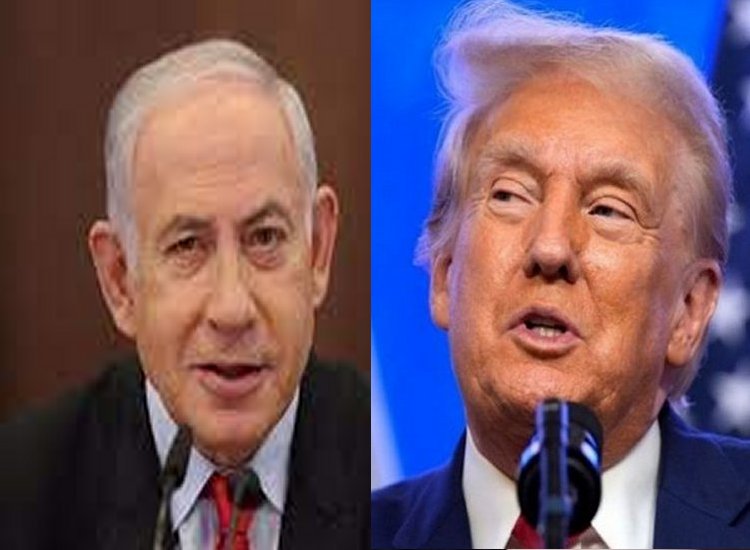
US President Donald Trump has pledged to keep military forces stationed in the Middle East until a peace agreement with Iran is secured, warning of a significant escalation in conflict if compliance is not met, as oil prices increased amid concerns about supply disruptions and restrictions in the Strait of Hormuz.
Mr Trump said in a social media post that US naval vessels, aircraft, and personnel, equipped with additional ammunition and weaponry, would remain deployed to eliminate, if required, “a substantially degraded enemy”, while also expressing optimism that a durable agreement would be reached and upheld, reports RTE.
“If for any reason it is not, which is highly unlikely, then the ‘Shootin’ Starts,’ bigger, and better, and stronger than anyone has ever seen before,” Mr Trump said, adding that contrary to “fake rhetoric”, Iran had agreed not to pursue nuclear weapons and to reopen the Strait of Hormuz,
“In the meantime our great Military is Loading Up and Resting, looking forward, actually, to its next Conquest. AMERICA IS BACK!” reports RTE.
Although both the United States and Iran have each claimed success in a five-week-long conflict that has resulted in thousands of deaths, their fundamental disagreements remain unresolved, with both sides maintaining opposing conditions for a deal that could influence the Middle East for generations.
Mr Trump’s recent statement followed the most extensive coordinated strike of the conflict by Israel yesterday, which resulted in more than 250 fatalities in Lebanon, prompting Iran’s chief negotiator to warn that Israel’s escalation alongside Washington’s demand for Tehran to abandon its nuclear ambitions could threaten ongoing peace discussions, reports RTE.
“In such a situation, a bilateral ceasefire or negotiations were unreasonable,” Iran’s parliament speaker Mohammed Bager Qalibaf, said in a statement yesterday,
Israel’s wave of air strikes on Wednesday has raised doubts about efforts to secure a regional truce, amid mixed signals regarding the extent of the ceasefire and sharply differing priorities for peace talks scheduled to begin on Saturday in Pakistan, reports RTE.
The United States and Israel have stated that Lebanon is not part of the agreement, while Iranian President Masoud Pezeshkian has insisted that a ceasefire in Lebanon is a key condition for Tehran’s deal with Washington.
The Iran-backed Hezbollah said it launched rockets early today at the small kibbutz of Manara, citing what it described as Israeli violations of the ceasefire and warning of further action until what it called “Israeli-American aggression” comes to an end, reports RTE.
Pakistan’s foreign ministry criticised the Israeli operations today, stating that they “undermine international efforts to establish peace and stability”.

French President Emmanuel Macron earlier said Lebanon “must be fully covered” by the ceasefire, while British Foreign Minister Yvette Cooper said the UK strongly supports including Lebanon in the Middle East truce, reports RTE.
The two sides also appeared far apart regarding Iran’s nuclear programme, one of the central issues cited by Mr Trump as a justification for the conflict.
Mr Trump said Iran had agreed to halt uranium enrichment, which can be used in nuclear weapons, and the White House indicated that Tehran would hand over its existing stockpiles, reports RTE.
“The United States will, working with Iran, dig up and remove all of the deeply buried … Nuclear ‘Dust,” Mr Trump said on social media yesterday,
Mr Qalibaf, however, said Iran would still be permitted to continue enriching uranium under the ceasefire terms, reports RTE.
Iran’s delegation for the negotiations is expected to arrive in Islamabad tonight.
“Despite scepticism of Iranian public opinion due to repeated ceasefire violations by Israeli regime … Iranian delegation arrives tonight in Islamabad for serious talks based on 10 points proposed by Iran,” Ambassador Reza Amiri Moghadam said in a post on X on Thursday, reports RTE.
‘Freedom of navigation means navigation must be free’
Oil prices rose today as investors remained concerned about the fragility of the truce and ongoing geopolitical risks affecting Middle Eastern supply, with uncertainty over whether restrictions in the Strait of Hormuz would be lifted soon.
There was little indication that the strait had reopened in any meaningful capacity since the agreement, with Iran continuing to assert control over the crucial route—a channel for roughly a fifth of global oil and liquefied natural gas shipments—while imposing tolls for safe passage, reports RTE.
Tehran’s demonstrated capability to disrupt Gulf energy supplies through its control of the strait, despite decades of extensive US military investment in the region, highlights how the conflict has already shifted the balance of power in the Gulf.
Iran’s Islamic Revolutionary Guard Corps navy released a map today outlining alternative shipping routes in the Strait of Hormuz to help vessels avoid naval mines, according to the semi-official Iranian news agency ISNA, reports RTE.
The map indicates that Iran may be preparing to reopen the Strait, though the continued presence of sea mines means the waterway remains hazardous and that a full reopening could take several days or longer.
British Foreign Secretary Yvette Cooper is expected to say today that transit through the Strait of Hormuz must remain free of tolls, opposing Iran’s efforts to exert control over a passage long regarded as an international waterway, reports RTE.
“The fundamental freedoms of the seas must not be unilaterally withdrawn or sold off to individual bidders. Nor can there be any place for tolls on an international waterway,” Cooper will say in an annual foreign policy speech in London, according to advance extracts. Freedom of navigation means navigation must be free,” reports RTE.
Tell us your thoughts in the Facebook post and share this with your friends.
