

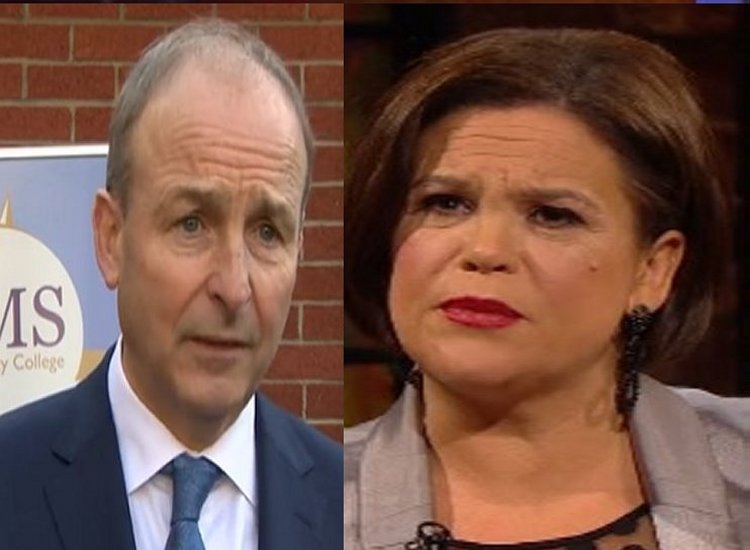
Sinn Féin leader Mary Lou McDonald has told the Dáil that the energy crisis is not easing but instead worsening, reports RTE.
She said that 750,000 households relying on home heating oil have experienced a doubling of their bills, reports RTE.
She argued that the Government’s stance suggests conditions will deteriorate further, with no reconsideration of support measures until October.
“And now families face rising school transport costs and the return of Junior and Leaving Cert fees. That’s what you’re bringing to people’s doors, reports RTE.
“You scrapped energy credits. You refused even to cut carbon tax on home heating oil when people needed relief most,” she said, reports RTE.
The Taoiseach responded that the conflict in the Middle East has caused a major disruption to energy supply, with countries worldwide dealing with the consequences.
Micheál Martin said that after a €750 million intervention, it is reasonable for the Government to keep the situation under review while exploring longer-term solutions to ease pressure on households, reports RTE.
He maintained that the Government has acted promptly in recent years to support people.
“Over the last number of years, we brought in very significant schemes that permanently reduced the cost of living for people,” he said, reports RTE.
Separately, the UN’s Food and Agriculture Organization has cautioned that increases in food price inflation later this year could trigger a global agri-food crisis if shipping through the Strait of Hormuz is disrupted.
Speaking on RTÉ’s Today with David McCullagh, Dr Oliver Moore of the Centre for Cooperative Studies at University College Cork said Ireland’s emphasis on food exports, alongside insufficient policies supporting domestic production, has heightened the risk of price shocks, reports RTE.
“We’re especially exposed because we’re an island off the north-west coast of Europe and we’ve really focused on agri-food exports, reports RTE.
“We’ve kind of let the domestic ball slip really. We’re losing vegetable growers all the time, reports RTE.
“We don’t even have targets in Food Vision 2030 for what our domestic market could be and could grow to. We have exported €19 billion worth of food last year, but we are importing about €12 billion,” reports RTE.
Dr Moore said around half a million people in Ireland are already experiencing food poverty, with families potentially spending up to a third of their income on healthy food.
He called for greater focus on local production and suggested exploring a basic income scheme similar to supports for artists and musicians, reports RTE.
Also speaking on the programme, Dr Peter Alexander, Senior Lecturer in Global Food Security at the University of Edinburgh, said the current crisis stems from reliance on inorganic fertilisers derived from natural gas.
“A large percentage of it passes through the Straits of Hormuz, something like 30%. That has potential to really disrupt food production, particularly if farmers choose to fertilise less and not plant crops, reports RTE.
“And that has the potential to lock in future reductions in the supply of food, which we in the UK and Ireland would experience primarily, in my view, through higher food prices, greater food price inflation,” reports RTE.
TheLiberal.ie won’t quit
Please support us with a small donation on PayPal!

He added that lower-income populations globally would be less able to afford adequate nutrition, with serious consequences.
Dr Alexander noted that staple crops such as corn, wheat and rice have seen yields increase fourfold since the 1960s Green Revolution, largely due to fertiliser use, reports RTE.
“And therefore, they’re tied to energy prices and they’re tied to the supply chain that we know so well, both from the war in Ukraine and the war in Iran,” reports RTE.
He said that in wealthier countries, the main impact would be rising prices rather than shortages.
Dr Moore added that Ireland is facing simultaneous pressures from a fuel crisis and a fertiliser crisis, combined with just-in-time supermarket supply chains and market concentration.
He said that much of modern food storage occurs during transportation via trucks and ships, which depend on fossil fuels, reports RTE.
“There was all the tariffs that Trump landed on the world as well. So, there’s a cascade of crises landing at the one time. And we don’t even have targets for growing our domestic food production,” reports RTE.
Dr Moore highlighted that low local food prices undermine the viability of domestic agriculture.
“We always had a poor local food provisioning system because we were an extractive colony, but now we’re an exporting economy, reports RTE.
“So, we’ve decided to have a very low cost approach to food, which destroys the farming base, because if it is that cheap, farmers can’t survive,” reports RTE.
However, he said alternative models are possible.
“If you look at Dulhallow Food Services, for example, they provide meals on wheels and school meals to 4,000 people every day and local farmers feed into that, reports RTE.
“So, there’s markets that can be created and generated through public provisioning, which could be done well, and then farmers could have multiple routes to market,” reports RTE.
Dr Moore said Ireland needs to reduce reliance on supermarkets and global trade, warning that dependence has increased vulnerability.
“So, we need to build in food sovereignty, proper resilience and people participation in the food system and start to grow our producer base because it is getting dangerously, dangerously low,” he said, reports RTE.
Asked about Ireland’s strong food security rankings, Dr Moore said these are based on global trade stability, which has been undermined by US tariffs and disruptions in the Strait of Hormuz.
He said such rankings do not reflect actual domestic production capacity, reports RTE.
Dr Alexander said caution is needed when expanding local food production, as it can be vulnerable to weather events, and that a balance between local and global supply is preferable.
Dr Moore argued Ireland remains overly reliant on global food systems, rooted in historical patterns, reports RTE.
“Our colonial history – we just ended up being a place that stuff was taken from and sent around the world. And we have kept that system going. We export nine times more meat and milk than we could ever consume, reports RTE.
“We don’t have a diversified agri-food system in Ireland. We’re obviously still going to keep trading to some extent. It’s just that we’re not actually building in proper resilience,” reports RTE.
Dr Moore said he believes Bord Bia could take a stronger role in promoting domestic food production.
“We need housing, fuel, and food sovereignty these days, rather than just hoping it’s going to work out well with the markets. We are low on infrastructure, but high on income,” he said, reports RTE.
Tell us your thoughts in the Facebook post and share this with your friends.

