

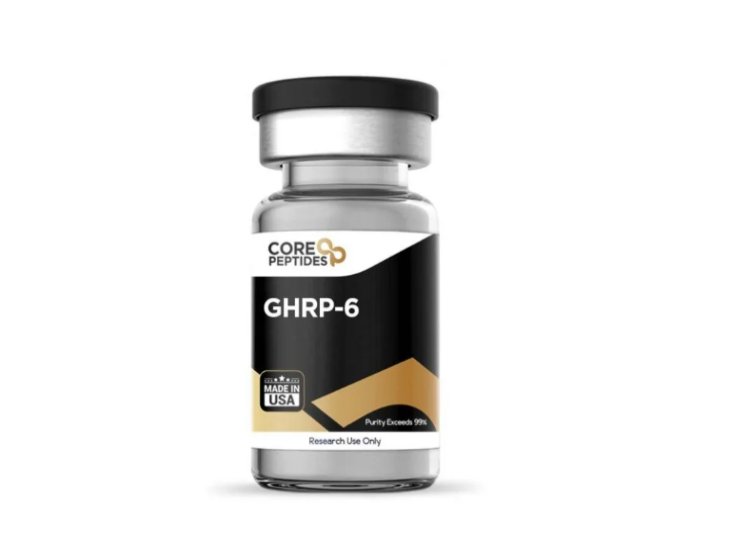
The growth hormone-releasing peptide-6 (GHRP-6) has gained considerable interest in scientific research due to its distinct biochemical structure and properties. As a synthetic hexapeptide, GHRP-6 is categorized within the class of growth hormone secretagogues, compounds believed to stimulate the release of growth hormone (GH) from the anterior pituitary gland.
This peptide has been the focus of investigations seeking to unravel its impacts on various physiological and biochemical processes in organisms. With its hypothesized potential to interact with specific receptors, such as the ghrelin receptor (growth hormone secretagogue receptor, GHSR), GHRP-6 may hold significant promise for diverse research fields, ranging from endocrinology to tissue regeneration and metabolic regulation.
Mechanisms of Action and Biochemical Characteristics
GHRP-6 is theorized to function by binding to GHSR, a receptor found primarily in the hypothalamus and pituitary. This receptor is also activated by ghrelin, a naturally occurring peptide hormone involved in appetite regulation and energy homeostasis. Research indicates that GHRP-6 may emulate ghrelin’s binding activity, potentially stimulating the release of growth hormone through both direct and indirect pathways. Studies suggest that this peptide might activate intracellular signaling cascades, such as the phospholipase C (PLC) and protein kinase C (PKC) pathways, which are considered to be critical for hormone secretion.
Interestingly, GHRP-6 is believed to exhibit resistance to enzymatic degradation in comparison to endogenous peptides, which may make it an appealing candidate for long-term biochemical studies. Its molecular stability is thought to allow researchers to hypothesize about its sustained impacts on target tissues and regulatory systems in organisms.
Metabolic Applications and Investigative Possibilities
GHRP-6’s potential role in metabolic research is considered noteworthy. Growth hormone is widely regarded as an influential regulator of lipid, carbohydrate, and protein metabolism. Research indicates that by possibly enhancing GH release, GHRP-6 might influence these pathways, making it a possible tool for studies exploring the complex interactions between anabolic and catabolic processes in laboratory models.
One area of interest is the peptide’s hypothesized impact on adipose tissue dynamics. Growth hormone has been associated with lipolytic activity, which may translate to changes in fat cell deposition and mobilization. Investigations purport that GHRP-6 might thus serve as a research tool for understanding how peptide-mediated GH release influences lipid metabolism. Similarly, its potential to support nitrogen retention and protein synthesis has prompted investigations into its exploration in muscle physiology studies, particularly in the context of muscle maintenance and growth.
GHRP-6 has also been hypothesized to influence insulin-like growth factor 1 (IGF-1) levels, a downstream mediator of GH activity. IGF-1 is believed to play a critical role in cell proliferation, differentiation, and metabolic regulation, suggesting that the peptide might hold value in experimental models examining these processes.
Potential Impacts on Tissue Processes
The peptide’s purported potential to modulate GH and IGF-1 levels has opened avenues for research into tissue repair and regeneration. GH is theorized to enhance cellular repair mechanisms, while IGF-1 is known to stimulate the proliferation of satellite cells, which are essential for tissue recovery. Studies suggest that GHRP-6 might hold value in exploring strategies to promote recovery in models of tissue injury or degenerative conditions.
Additionally, GHRP-6’s potential anti-inflammatory impacts have garnered interest in research exploring chronic inflammation and its implications for regenerative biology. It is hypothesized that the peptide could modulate cytokine profiles, potentially aiding in the resolution of inflammatory states. This speculative property positions GHRP-6 as a candidate for investigations into inflammatory regulation and its downstream impacts on tissue integrity.
Neurological and Cognitive Research Implications
Beyond its metabolic and regenerative potential, GHRP-6 might hold significance in neurological research. The ghrelin receptor, which GHRP-6 is thought to target, is expressed in several brain regions, including the hippocampus, which is associated with learning and memory.
Investigations have suggested that ghrelin receptor activation may influence neuroplasticity, cognitive function, and stress response. These findings imply that GHRP-6 could be a relevant compound for studying the molecular underpinnings of brain function and the potential impacts of GH secretagogues on neural systems.
The hypothesized neuroprotective properties of GHRP-6 also warrant exploration. Growth hormone has been linked to the modulation of neuronal survival and repair, particularly under conditions of oxidative stress. By potentially increasing GH release, GHRP-6 has been hypothesized to provide insights into mechanisms of neural resilience and recovery in experimental models of neurodegenerative conditions.

Cardiovascular Research Opportunities
The cardiovascular system represents another area where GHRP-6 might hold promise for research. Studies have suggested that ghrelin receptor activation is associated with cardioprotective properties, including vasodilation and reduced oxidative stress. GHRP-6’s potential to stimulate GH release could further contribute to cardiovascular investigations, as GH and IGF-1 are known to influence cardiac muscle physiology and vascular integrity.
Preliminary hypotheses indicate that GHRP-6 might reduce cardiac stress and support vascular remodeling, particularly in laboratory models of ischemia or hypertensive conditions. These speculative impacts make it an intriguing candidate for understanding the interplay between peptide-mediated signaling and cardiovascular function.
Impacts on Appetite and Energy Research
The ghrelin receptor’s role in appetite and energy balance has spurred interest in GHRP-6 as a tool for studying these systems. While GHRP-6 is not ghrelin, its potential to interact with the same receptor has led researchers to explore its potential impacts on hunger signals, energy intake, and metabolic expenditure. These investigations are particularly relevant in models of metabolic dysregulation, such as obesity or anorexia, where energy homeostasis is disrupted.
Additionally, it has been hypothesized that GHRP-6 might influence mitochondrial function, an area of growing interest in energy metabolism research. Mitochondria are the powerhouses of cells, and their efficiency plays a crucial role in overall organismal integrity. Findings imply potentially modulating mitochondrial dynamics through GH-dependent and independent pathways; GHRP-6 may aid in unraveling the complexities of cellular energetics.
Considerations for Future Research
Despite its promising attributes, the scientific community recognizes the need for extensive research to elucidate the scope of GHRP-6’s impacts fully. Variability in organismal responses, dosing paradigms, and receptor sensitivity are areas that remain to be systematically explored.
Furthermore, while current hypotheses focus heavily on GH-related mechanisms, GHRP-6’s potential off-target impacts should not be overlooked. Understanding its broader receptor interactions and downstream signaling pathways could uncover novel implications in fields ranging from oncology to cellular aging research.
Conclusion
The GHRP-6 peptide offers a compelling avenue for scientific exploration, with potential relevance in research spanning metabolic, regenerative, neurological, and cardiovascular research domains. Its potential to interact with the ghrelin receptor and influence GH release places it at the forefront of peptide-based investigations. While much remains to be understood about its full range of impacts, the speculative potential of GHRP-6 underscores its value as a potentially versatile tool in the pursuit of scientific knowledge. By advancing our understanding of this peptide, researchers may unlock novel insights into fundamental biological processes and the intricate mechanisms governing organismal function.
References
[i] Bowers, C. Y., Momany, F. A., Reynolds, G. A., & Hong, A. (1984). On the in vitro and in vivo activity of a new synthetic hexapeptide that acts on the pituitary to specifically release growth hormone. Endocrinology, 114(5), 1537–1545. https://doi.org/10.1210/endo-114-5-1537
[ii] Smith, R. G., Cheng, K., Schoen, W. R., Pong, S. S., Hickey, G., Jacks, T., & Patel, S. (1993). A nonpeptidyl growth hormone secretagogue. Science, 260(5114), 1640–1643. https://doi.org/10.1126/science.8511598
[iii] Kojima, M., Hosoda, H., Date, Y., Nakazato, M., Matsuo, H., & Kangawa, K. (1999). Ghrelin is a growth-hormone-releasing acylated peptide from stomach. Nature, 402(6762), 656–660. https://doi.org/10.1038/45230
[iv] Arvat, E., Broglio, F., & Ghigo, E. (2000). Insulin-like growth factor I: Implications in aging, neurodegeneration, and longevity. Frontiers in Neuroendocrinology, 21(1), 57–95. https://doi.org/10.1006/frne.1999.0184
[v] Nagaya, N., Moriya, J., Yasumura, Y., Uematsu, M., Ono, F., Shimizu, W., … Kangawa, K. (2001). Effects of ghrelin, a novel growth hormone–releasing peptide, on cardiac function in animal models of heart failure. Circulation, 104(12), 1430–1435. https://doi.org/10.1161/hc3501.094511

