

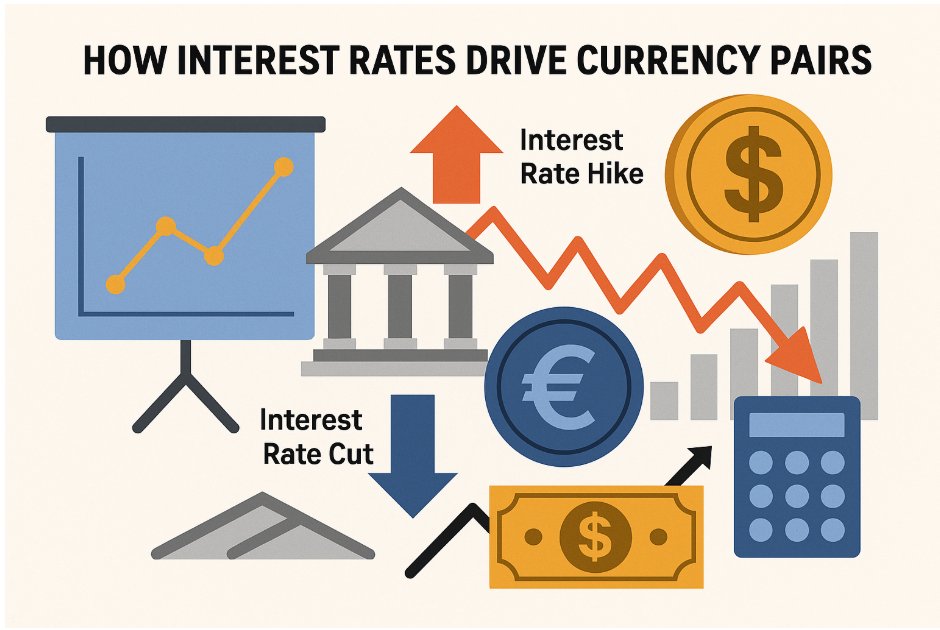
Imagine sitting in a trading room in New York, screens flickering with charts, and the Fed’s announcement hits the wires. Suddenly, the USD surges against the euro, wiping out positions or minting fortunes in seconds. This isn’t fiction; it’s the raw power of interest rates at work. As a trader with years in international banks, I’ve seen how these decisions ripple through global markets, turning calm seas into storms.
Interest rates aren’t just boring policy tools. They’re the heartbeat of currency movements, dictating where capital flows and how economies breathe. When central banks tweak them, currencies dance. Think about 2022 to 2023: the Federal Reserve hiked rates aggressively to combat inflation, boosting the dollar while the euro and yen stumbled. Traders who anticipated this made bank; others learned hard lessons.
In this article, we’ll unpack how interest rates steer currency pairs. We’ll start with the basics, dive into the mechanics, explore real-world examples, and wrap up with tips you can use. By the end, you’ll see rates not as abstract numbers but as actionable signals. Whether you’re a newbie or seasoned pro, understanding this dynamic can sharpen your edge in forex trading.
The Basics: What Interest Rates Are and How They Link to Currencies
At their core, interest rates represent the cost of borrowing money. Central banks set benchmark rates, like the Fed Funds Rate in the US or the ECB’s main refinancing rate in Europe. These influence everything from loans to savings, guiding economic activity.
Higher rates make a currency attractive. Why? Investors chase yield. If US rates climb while Japan’s stay near zero, capital floods into dollar-denominated assets, strengthening the USD against the JPY. This is the essence of interest rate differentials, or IRD: the gap between two countries’ rates.
To calculate a simple IRD, subtract one rate from the other. For instance, if the Fed’s rate is 5% and the Bank of Japan’s is 0.1%, the differential favors the dollar by 4.9%. Positive differentials often predict currency appreciation.
But it’s not just about current rates. Expectations matter too. Markets price in future hikes or cuts based on data like inflation reports or GDP figures. As an analyst, I’ve pored over economic calendars, knowing a surprise CPI release can flip a pair overnight.
Consider major pairs like EUR/USD or GBP/USD. When the ECB lags the Fed in tightening, the euro weakens. Emerging market currencies, like the Mexican peso, amplify this: high US rates pull capital away, pressuring them downward.
To visualize, here’s a quick table of key central bank rates as of early 2025:
| Central Bank | Benchmark Rate | Recent Change | Impact on Currency |
| Federal Reserve (US) | 4.75-5.00% | Paused after hikes | Strengthens USD |
| European Central Bank (EU) | 3.75% | Cut from 4.00% | Weakens EUR |
| Bank of Japan (Japan) | 0.25% | Slight increase | Stabilizes JPY |
| Bank of England (UK) | 5.00% | Held steady | Supports GBP |
This snapshot shows how differentials drive flows. Track these, and you’ll spot opportunities before the crowd.
TheLiberal.ie won’t quit
Please support us with a small donation on PayPal!

Mechanisms of Influence: How Rates Move Currency Pairs
The direct link is straightforward: rate hikes signal a strong economy, drawing investment and lifting the currency. Cuts suggest weakness, sparking outflows and depreciation.
Yet, it’s a chain reaction. Rates combat inflation; unchecked price rises erode purchasing power, weakening money. A hawkish central bank one that favors hikes keeps inflation in check, bolstering confidence.
Carry trades exploit this. Borrow in a low-rate currency, like the yen, and invest in a high-yield one, like the Aussie dollar. Profits come from the differential plus any appreciation. But beware unwindings: when rates converge unexpectedly, trades reverse violently.
Volatility spikes around announcements. I’ve traded through Fed meetings where dovish hints tanked the dollar in minutes. Tools like yield curves help forecast: an inverted curve often precedes cuts and currency slides.
Global factors amplify effects. Geopolitical tensions or recessions make safe-haven currencies, like the USD or CHF, more sensitive to rate changes. In interconnected markets, a US hike can ripple to Asia, pressuring export-dependent economies.
For pairs, correlations are key. USD strength from high rates often hurts commodity currencies like CAD or AUD. Use technicals alongside: RSI for overbought signals during rate-driven rallies.
Historical Examples and Lessons for Traders
History is the best teacher. Take the 1990s Japanese carry trade boom. With rates near zero in Japan and climbing in the US, traders borrowed yen to buy dollars, fueling a massive USD/JPY rally. But the 1998 unwind, triggered by Russian default, crashed the pair. Lesson: differentials lure, but risks lurk.
Fast forward to 2016 Brexit. The Bank of England slashed rates amid uncertainty, plunging GBP/USD from 1.50 to 1.20 in months. Traders who shorted early profited; those caught long faced wipeouts.
More recently, post-COVID dynamics shine. In 2020, zero rates worldwide weakened the USD as stimulus flooded markets. By 2022-2023, Fed hikes reversed this, pushing USD/JPY to 150+. As rates peaked in 2024, easing hints softened the dollar, offering reversal plays.
In any USD/JPY trading guide, you’ll see rates as the core driver. Japan’s persistent low yields make it a classic differential play, but interventions add twists.
Key takeaways for traders: Always blend fundamentals with charts. Monitor differentials via tools like Bloomberg terminals or free sites. Diversify: don’t bet everything on one announcement. Use stops to manage volatility. Start small on demo accounts to test rate-based strategies.
From my bank days, I recall a trade where anticipating ECB cuts shorted EUR/USD profitably. Patience pays; overleveraging on carry often backfires.
Wrapping It Up: Mastering Rates for Currency Success
Interest rates are the invisible hand guiding forex. Differentials dictate flows, expectations fuel moves, and history warns of pitfalls. Grasp this, and you’ll navigate pairs with confidence.
Looking ahead to late 2025, with potential Fed cuts and ECB stability, watch for EUR/USD rebounds. Emerging trends like digital currencies might disrupt, but traditional rates remain king.
Apply what you’ve learned: scan calendars, calculate IRDs, and trade smart. Rates aren’t just data; they’re your roadmap to profits. Stay informed, stay disciplined, and the markets will reward you.

