

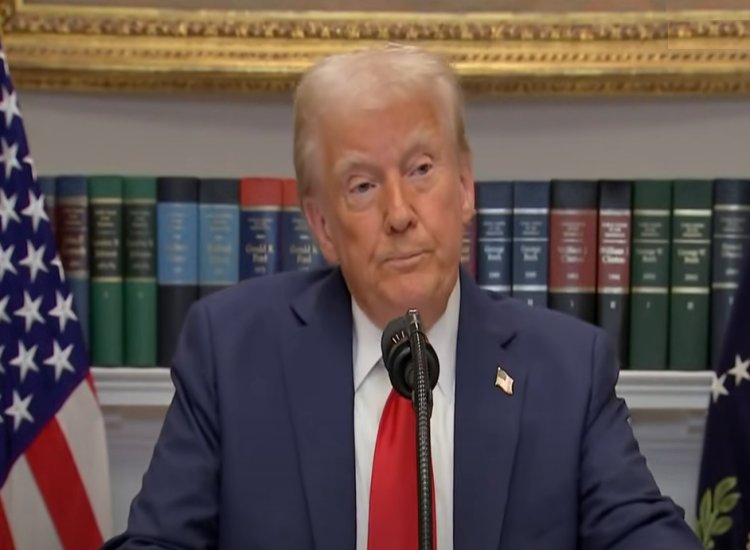
Donald Trump has announced that the United States will hike tariffs on Canadian imports, raising them to 35% starting next month. He also indicated plans to apply general tariffs of 15% to 20% on the majority of other global trade partners, reports RTE.
In a letter posted on his social media platform, Mr Trump informed Canadian Prime Minister Mark Carney that the tariff increase would begin on 1 August and could rise further if Canada retaliates.
Posting on X yesterday, Mr Carney stated that his administration remains committed to protecting Canadian workers and businesses in negotiations with the US ahead of the approaching deadline, reports RTE.
The new 35% tariff is an increase from the previous 25% rate imposed by Mr Trump and deals a setback to Mr Carney’s efforts to secure a trade agreement with Washington.
Goods covered under the United States-Mexico-Canada Agreement (USMCA) are still expected to be exempt, and 10% tariffs on energy and fertilizer remain unchanged, though a final decision on those areas has not been made, according to a US official, reports RTE.
In his letter, Mr Trump criticized Canada for what he called the influx of fentanyl across the border and for trade policies that he claims harm US dairy producers and other sectors.
He described the trade imbalance as a danger to both US economic stability and national safety.
“If Canada works with me to stop the flow of Fentanyl, we will, perhaps, consider an adjustment to this letter,” Mr Trump wrote, reports RTE.
Canadian authorities say only a very small amount of fentanyl originates in their country, but they have implemented steps to tighten border control.
“Canada has made vital progress to stop the scourge of fentanyl in North America. We are committed to continuing to work with the United States to save lives and protect communities in both our countries,” Mr Carney added in his X post late Tuesday, reports RTE.
Last month, the prime minister mentioned that he and Mr Trump had agreed to finalize a new economic and security accord within 30 days.

In recent days, Mr Trump has extended his trade disputes, introducing fresh tariffs against various nations, including allies such as Japan and South Korea, and announcing a 50% tariff on copper, reports RTE.
This latest move caused fresh concern among investors, with both US and European stock futures declining in Asian trading as markets braced for an upcoming tariff decision on the European Union.
“The potential escalation between the EU and the US is a big deal for financial markets,” said Joseph Capurso, head of international economics at the Commonwealth Bank of Australia, reports RTE.
“If you get something similar to (the US-China trade war in April), that’s going to be very destabilising” reports RTE.
Speaking to NBC News in an interview released yesterday, Mr Trump noted that more countries might soon face new tariffs, even if they haven’t received formal letters yet.
“Not everybody has to get a letter. You know that. We’re just setting our tariffs,” Mr Trump said in the interview. “We’re just going to say all of the remaining countries are going to pay, whether it’s 20% or 15%. We’ll work that out now,” Mr Trump was quoted as saying by the network, reports RTE.
Myanmar’s military leader has requested that Mr Trump reduce the current 40% tariff on its exports to between 10% and 20%, and is prepared to send negotiators to Washington, state media reported.
The president of the Philippines is scheduled to meet with Mr Trump in Washington this month, where discussions will include the country’s 20% tariff, according to its foreign minister, reports RTE.
Canada ranks as the United States’ second-largest trading partner after Mexico and is the top buyer of American exports. It purchased $349.4 billion in US goods last year and sold $412.7 billion in goods to the US, based on US Census Bureau statistics.
Mr Carney, whose Liberal Party returned to power earlier this year on a platform promising to resolve trade tensions with the US, was targeting a trade deal by 21 July, reports RTE.
In his letter, Mr Trump didn’t detail how trade talks were going, but did note that “tariffs may be modified, upward or downward, depending on our relationship with your Country”.
In June, the Carney administration withdrew a proposed digital services tax on American tech companies after Mr Trump suddenly halted trade discussions, calling the tax a “blatant attack”, reports RTE.
Tell us your thoughts in the Facebook post and share this with your friends.

