

Migrant families in Northern Ireland are still living in fear following the riots that erupted earlier this week, predominantly in loyalist areas of the city.
Video footage of a knife attack on Monday night was widely shared online and triggered three nights of violent protests largely targeting Northern Ireland’s migrant communities, reports RTE.
Hadi Alodid, originally from Sudan, appeared in court on Wednesday charged with attempted murder, possession of a knife and making threats to kill a hospital radiographer.
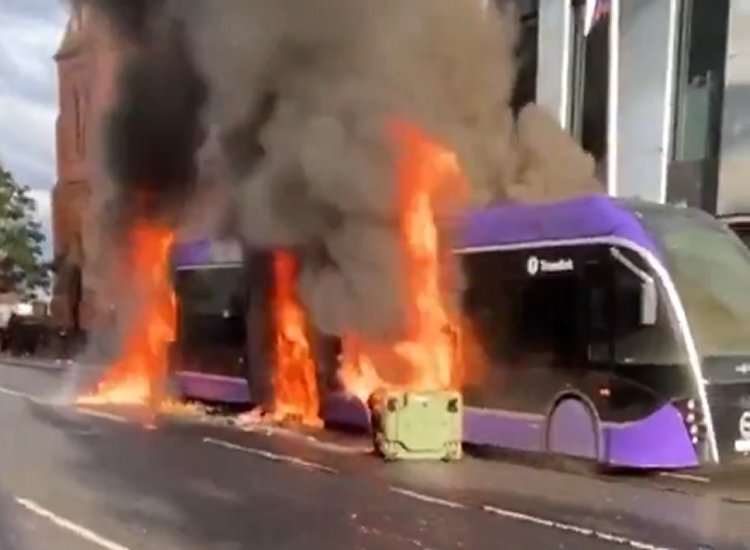
Many migrants were forced to flee their homes as lists of addresses where non-white people lived were circulated online, with some families burned out of their homes and multiple vehicles set alight during the riots, reports RTE.
When Hossam discovered his home was on a so-called “hit list” appearing to target migrant families, he and his family left and spent a night in a local church before moving to a hotel.
The following day, his neighbours told him the violence had died down and it would be safe to return, reports RTE.
“It’s still scary,” he told RTÉ’s This Week programme.
When he slept in his own home the following night, he said he did not feel safe, reports RTE.
“When I come here [to Belfast] I felt really safe … now we are really scared about the future.
“We don’t know if that can happen again,” he said, reports RTE.
Hossam and his family were among the hundreds of migrants in Belfast assisted by a network of volunteers from various organisations across the city during the unrest.
As migrants suddenly found themselves under threat, these volunteers helped people find safe accommodation, food and information — in some cases assisting them in leaving the North entirely, reports RTE.
Jahswill Emmanuel, who has lived in Northern Ireland for 23 years, said some migrants concluded it was safer to take a ferry to Britain or travel to Dublin than remain in Belfast.
“I had a call from a migrant family that called me and said they can’t – maybe it’s true or it’s not true – but their address on the list, they just have to go to Dublin.
“They went to Dublin that very evening, which is very devastating,” Mr Emmanuel said, reports RTE.
“And some people even travelled to London. Some people, they had to leave their home and went to churches to sleep.”
Mr Emmanuel also delivered food parcels to families too frightened to leave their homes, reports RTE.
“I love Belfast,” he said from his office at the Multi-Ethnic Sports and Cultures NI, a charity he founded to promote racial harmony.
As a precaution, the homework club run by his charity was cancelled, as were weekend matches in the sports league the charity is running, reports RTE.
“Belfast is very, very diverse at a minute compared to when I came to Northern Ireland 23 years ago.
“We have so many cultures now – vibrant cultures in Northern Ireland.
“People are welcoming, they are nice, they say hi to you, they greet you, they want to help you. And we also have people that don’t want to see you.
“They want you out of here, they want you shipped out by boat back to Africa,” Mr Emmanuel said, reports RTE.
Racially motivated violence
Last June, racial violence erupted in Ballymena and spread to other areas after two Romanian teenagers were accused of attempting to rape a schoolgirl — charges that were later dropped.
TheLiberal.ie won’t quit
Please support us with a small donation on PayPal!

Many people feared the Monday night attack could trigger similar racially motivated violence, reports RTE.
Francisco Mok, who lives in East Belfast, was advised to leave work early before roads were closed and public transport was suspended.
His home was not targeted, but the following morning he walked past burned-out cars and houses, reports RTE.
“I was upset because this is the street that we walk up and down,” he said.
“I didn’t know that there are people there who are bad people that will keep prejudice in their mind whenever something small happened … we are the innocent ones that has to pay for it,” reports RTE.
Asked if he felt threatened by what he witnessed, he replied “of course.”
“I feel unsafe in the area where I live, especially like the day after because you have to keep an eye out all the time.
“You have to be cautious [about] what’s going on around you.
“So, you constantly, constantly have that kind of unsafety in your mind,” he added, reports RTE.
He said that before this week he did feel safe in Belfast, but on Tuesday “suddenly everything changed drastically.”
“We feel like we also belong to this country, belong to Northern Ireland, belong to Belfast, part of the community,” he said, reports RTE.
Mr Mok said the attacks this week reminded him of what happened in Ballymena.
“It means that whatever’s going on in these people, these rioters mind, although they’re like being kind to us, nice to us, but then when something happens [involving a person of colour] probably they will trigger and they will make it bigger and they will kind of blame it on us,” reports RTE.
There have now been several incidents in recent years across Ireland and the UK where a single incident involving allegations against a migrant has led to racially motivated violence.
“By now there’s an almost depressing pattern to how things can play out in the wake of an incident or even allegations of an incident,” said Ciaran O’Connor, Senior Analyst at the Strategic Institute for Dialogue, which monitors online hate and extremism, reports RTE.
“We saw with Dublin in November 2023, we saw after Southport across the UK, we saw it Ballymena last year and Belfast here.”
The pattern involves a “trigger event” in which a foreigner is alleged to have committed a brutal crime, after which rumours spread online and generate an emotional response.
“Social media can be used to encourage a response and be used for groups to communicate, to organise, and then to mobilise,” Mr O’Connor explained, reports RTE.
“We saw social media being used calling for protests in the case of Ballymena and I believe similarly in the case of Belfast, there were lists circulating online which purported to include addresses for various types of accommodation being used by migrants in different localities,” he added.
These lists were exploited by extremists after footage of Monday night’s knife attack emerged, reports RTE.
Most of the social media accounts monitored by ISD appeared to originate in Northern Ireland before being amplified by overseas users.
Sipho Sabanda, organiser and convenor of Black Leadership Activists with Social Change Initiative, said she had anticipated something might happen after the video of Monday’s attack was so widely circulated, having tracked the rising racial tensions through social media and certain political commentary, reports RTE.
“I knew that the racial undertones that we had seen in the previous weeks and the previous months had come to a point where everything was going to start blowing over,” she said.
Over several nights of racial violence in Belfast, migrants and people of colour were burned out of their homes, forced to flee, roads were blocked and businesses were forced to close, reports RTE.
Tell us your thoughts in the Facebook post and share this with your friends.

