

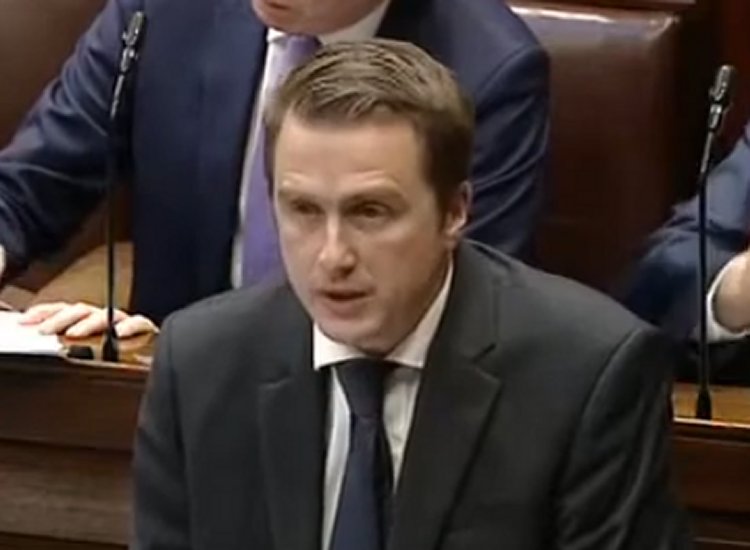
The Minister for Housing has said he expects the Short-Term Letting Bill he has brought before Cabinet will be the strongest legislation on the issue anywhere in Europe.
Minister James Browne said anyone letting a property for short-term stays will have to obtain planning permission and register with Fáilte Ireland, reports RTE.
He said those who fail to do so would be operating outside the law.
He said strong enforcement measures would be put in place around this, reports RTE.
“There’s always a risk of people operating in the black market, that’s where Revenue Commissioners do come in,” he said.
“It’s where the local authorities and enforcement come in, and there will be enforcement procedures. There are enforcement procedures there at the moment under local authorities to take action against people who are operating outside of the law.
“The challenge to date is for local authorities, in terms of that enforcement piece, is it is very difficult to prove who is actually operating as a short-term let, who is operating without planning permission and outside of the rules,” the minister added, reports RTE.
In February, the Government agreed in principle to restrict short-term lets in towns with a population of more than 20,000, having initially planned to cover towns with a population of 10,000.
Sinn Féin’s Eoin Ó Broin said the regulations are being watered down, reports RTE.
He referenced the fact that those operating short-term lets for seven years or more in urban areas will now have the chance to secure planning permission — something he described as yet another weakening of an already questionable regime.
However, Independent Ireland leader Michael Collins expressed concern that many homes available for short-term rent in rural areas may not be planning compliant, reports RTE.
The Cork South West TD fears this could adversely affect tourism.
The new rules will require short-term accommodation providers and those leasing out properties through Airbnb to register with Fáilte Ireland and hold the appropriate planning permission, as the Coalition tries to force more properties into long-term use to help ease the housing crisis, reports RTE.
Speaking to reporters at Government Buildings this afternoon, Mr Browne said “Airbnb will have to comply with the law and I would expect both the planning authorities and Fáilte Ireland to be very robust in actions against Airbnb, or any platform that [facilitates] illegal activity on their website.”

Mr Browne had hoped to have the register operational before now, but plans have stalled amid apparent disagreement between his department and the Department of Tourism, fronted by Peter Burke, reports RTE.
Under an EU regulation, the register was supposed to have been applicable by 20 May.
The register will apply to anyone offering paid accommodation for up to 21 nights, whether an entire property or a room within a home, reports RTE.
The minister informed Cabinet colleagues of a draft report — commissioned by The Housing Agency — which indicates there are 28,903 short-term lets currently available in Ireland, with cities accounting for approximately 40% of the national total and Dublin alone making up 9,186 short-term lets, or 32% of the total.
The report used Airbnb data as a proxy for short-term lettings more broadly, reports RTE.
The Coalition’s approach will generally preclude local authorities from issuing new planning permissions for short-term lettings in cities and towns, with the priority being to return homes to the private rental market rather than have them used for tourism.
The new register is expected to become operational in December, though this is contingent on legislation from Minister Burke passing through the Oireachtas, reports RTE.
Mr Burke’s Short-Term Letting and Tourism Bill provides a statutory basis for the introduction and operation of the register, which will be implemented and managed by Fáilte Ireland.
Speaking on RTÉ’s News at One, Mr Browne said the new law will come into force on 31 December, reports RTE.
“That’s so that Fáilte Ireland will create a register of short-term lets, and to be on that register you will have to have planning permission.”
In previous years, the Department of Housing has estimated that as many as 12,000 properties could return to the traditional long-term market as a result of the new rules, reports RTE.
Ministers had previously failed to reach agreement on the so-called “grace period” that will be available to short-term let property owners under the new regime.
Mr Browne said there would be a two-year grace period for towns with a population of under 20,000 to get their planning sorted out, reports RTE.
Mr Burke told the Fine Gael parliamentary party meeting last week that a potential administrative mechanism could be availed of by those who have been letting short-term properties for over seven years to ensure their planning affairs are in order.
Mr Browne said a “significant number” of homes had been transferred to commercial short-term lets in recent years and that he wanted to see them returned to use, reports RTE.
“I want those homes and those, as many as possible, back into use, available as homes, either to own or to rent, so as residential purposes, because it is impacting the housing crisis, in particular in the long-term rental sector,” he said, reports RTE.
Tell us your thoughts in the Facebook post and share this with your friends.

