

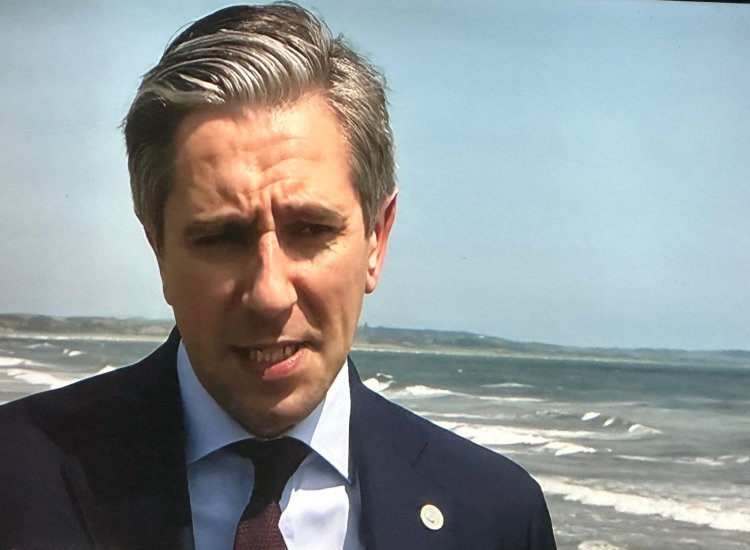
Tánaiste Simon Harris has called on the EU’s trade commissioner to exclude critical Irish sectors—such as aviation, medical technology, agri-food, and the horse industry—from any retaliatory tariffs that the EU may impose on US goods if ongoing trade talks break down, reports RTE.
In a letter to Maroš Šefčovič, obtained by RTÉ News, the Minister for Foreign Affairs and Trade urged the commissioner, who previously led EU Brexit negotiations, to ensure any EU countermeasures to President Donald Trump’s tariff threats do not harm Northern Ireland.
The correspondence outlines Ireland’s official stance as the deadline for a possible escalation in EU-US trade tensions approaches, reports RTE.
Talks between officials from the EU and US have intensified recently to try and prevent sweeping tariffs from Washington on European exports, which would likely trigger significant EU retaliation.
On April 2, President Trump announced 20% “reciprocal” tariffs on nearly all EU products, along with broad duties targeting several other nations, reports RTE.
Following bond market instability, Mr Trump delayed the 20% tariffs for 90 days, pushing the deadline to July 9.
This prompted negotiations between the European Commission, represented by Mr Šefčovič, and the Trump administration, led by Trade Secretary Jamieson Greer and Commerce Secretary Howard Lutnick, reports RTE.
Last month, Mr Trump warned of 50% tariffs on EU goods, citing stalled talks, but backed down after a phone call with Commission President Ursula von der Leyen.
Both US and EU negotiators have since stepped up efforts to strike a deal that would prevent reciprocal tariff action.
Still, the EU has drawn up a list of hundreds of US goods worth roughly €95 billion that could be targeted if talks collapse, reports RTE.
This list, released on May 8, is currently under a four-week consultation process between the Commission and member states.
Mr Harris’s letter outlines Ireland’s concern that the EU’s draft retaliation list could severely impact sectors vital to the Irish economy, reports RTE.
He wrote: “I have heard concerns both about the immediate impact of the proposed rebalancing measures on imports, but also about the potential for them to result in further retaliatory action by the US. I believe this is a reasonable and well-founded concern which we must also take account of in formulating our approach. It is particularly acute in the agri-food and drinks sector,” reports RTE.
The Tánaiste cited the potential threat to Ireland’s “leading” aviation sector, referencing Ryanair—Europe’s largest airline—and Ireland’s globally significant aircraft leasing industry, reports RTE.
The Government is worried that the leasing sector could be hit, as it depends heavily on spare parts from the US.

“Given the limited capacity of EU manufacturers to meet demand in the sector, I believe that rules of origin for goods with a very long service life, such as whole aircraft and helicopters, need to be very carefully considered in the eventual approach to applying tariffs,” reports RTE.
“Specifically, I would ask that used aircraft are excluded from import tariffs,” he wrote, reports RTE.
The Tánaiste also warned about the medtech industry, noting its deep integration with US supply chains.
He wrote: “I have consulted with stakeholders and have concerns about the potential impact of the proposed list, which includes a large number of tariff lines (around 800) which could potentially impact on essential medical devices for European patients,” reports RTE.
“I would ask that you engage in detail with the medtech sector to ensure that our rebalancing measures are targeted in a way that does not undermine this important sector and the lifesaving technologies they supply to consumers across the EU,” reports RTE.
He added that, although in theory companies could switch suppliers, in practice, this is not feasible in the short term due to certification and regulatory challenges.
Mr Harris also flagged another “serious concern in Ireland”: the possibility of EU tariffs on US animal feed imports, on which Irish agriculture heavily depends, reports RTE.
He wrote: “Increasing costs on these vital inputs will not only put further pressure on a stressed sector but risks feeding through in increased prices for consumers (in one area, beet pulp, Ireland accounts for the entirety of EU imports),” reports RTE.
He further expressed alarm at the inclusion of purebred horses in the EU’s draft retaliation list.
He wrote: “The equine sector provides significant employment in rural areas, with the US by the far the largest export market for Irish thoroughbreds outside the UK,” reports RTE.
“This trade depends on horses moving in both directions. I would ask that these items be removed from the list – doing so will have a very limited impact on the overall value of the list and would reduce disproportionate impact on Ireland,” reports RTE.
The Tánaiste ended the letter with a warning about the possible unintended effects on Northern Ireland due to its unique trade status post-Brexit.
“I would also like to highlight the need to minimise unintended consequences on Northern Ireland of the current situation to the extent possible,” he wrote, reports RTE.
“Considering your deep experience from EU-UK negotiations, and your continuing responsibilities in that relationship, I know you will appreciate that this is a politically sensitive topic and will need careful management,” reports RTE.
The Government is reportedly relieved that pharmaceuticals and dairy products are not on the list of potential EU countermeasures.
Officials confirmed that while categories such as aircraft, spirits (including whiskey), and medical devices are included, retaliatory tariffs would only take effect if talks fail—and possibly not at all if a deal is reached, reports RTE.
Although progress has been reported, it’s understood that the final decision on whether a trade agreement will prevent a tariff escalation rests with President Trump.
Tell us your thoughts in the Facebook post and share this with your friends.

