

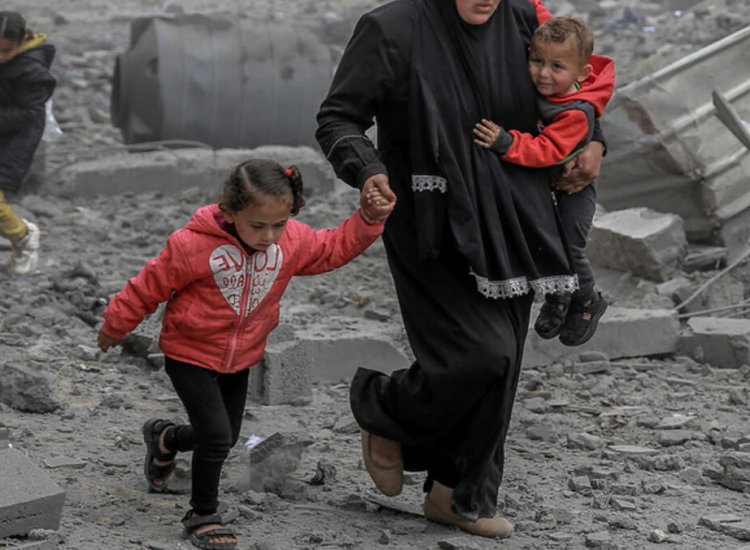
The UN human rights office has reported at least 798 fatalities over the past six weeks near aid distribution points in Gaza operated by the US- and Israeli-supported Gaza Humanitarian Foundation (GHF), as well as close to convoys led by other humanitarian groups, reports RTE.
The GHF, relying on private American security and logistics firms, brings aid into Gaza through a system that largely circumvents the UN’s coordination framework.
Following the deaths of many Palestinian civilians attempting to reach GHF’s aid centres in areas where Israeli troops are active, the UN described the foundation’s method of distributing aid as “inherently unsafe” and as breaching impartial humanitarian principles, reports RTE.
“(From 27 May) up until the seventh of July, we’ve recorded 798 killings, including 615 in the vicinity of the Gaza Humanitarian Foundation sites, and 183 presumably on the route of aid convoys,” UN rights office (OHCHR) spokesperson Ravina Shamdasani told a regular media briefing in Geneva, reports RTE.
The GHF, which started food distribution in Gaza at the end of May after Israel ended an 11-week aid blockade, dismissed the UN statistics as “false and misleading”.
The organisation has denied that any deadly incidents have taken place at its aid locations, reports RTE.
According to the OHCHR, its figures come from a combination of sources, including data from hospitals, cemeteries, relatives, Palestinian health services, NGOs, and its partners on the ground.
Ms Shamdasani noted that most of the injuries sustained by Palestinians near GHF distribution hubs since 27 May have been caused by gunfire, reports RTE.
“We’ve raised concerns about atrocity crimes having been committed and the risk of further atrocity crimes being committed where people are lining up for essential supplies such as food,” she said, reports RTE.
GHF said it has distributed more than 70 million meals to Gaza’s hungry population in just over a month, claiming that rival aid groups have had “nearly all of their aid looted” by Hamas or local criminals.
The UN’s humanitarian coordination office (OCHA) had previously reported violent theft of aid supplies, while the UN’s World Food Programme stated last week that most food delivery trucks entering Gaza were stopped by “hungry civilian communities”, reports RTE.
Food and basic supply shortages remain critical nearly two years into Israel’s bombardment of Gaza, which has left much of the territory in ruins and displaced the majority of its 2.3 million residents.
The new UN fatality count comes as Gaza’s civil defence body reported that Israeli forces killed 18 more people today, including ten who were queuing for aid in the southern part of the devastated region, reports RTE.
Civil defence official Mohammed al-Mughayyir said Israeli troops shot ten people waiting for aid in the Al-Shakoush area northwest of Rafah, where reports of deadly attacks on aid seekers are frequent.
TheLiberal.ie won’t quit
Please support us with a small donation on PayPal!

Six more individuals were killed in four separate Israeli airstrikes around Khan Yunis, also in southern Gaza, according to the civil defence agency, reports RTE.
Another two people died in drone attacks near Gaza City in the north, civil defence spokesperson Mahmud Bassal told AFP.
Meanwhile, Doctors Without Borders has reported a dramatic rise in acute malnutrition levels among the Gaza population, saying the situation is worsening rapidly.
The medical humanitarian group, also known as MSF, described the levels of malnutrition seen at two of its Gaza-based clinics as “all-time high”, reports RTE.
“MSF teams are witnessing a sharp and unprecedented rise in acute malnutrition among people in Gaza,” the organisation said in a statement, reports RTE.
“In Al-Mawasi clinic, southern Gaza, and the MSF Gaza Clinic in the north, we are seeing the highest number of malnutrition cases ever recorded by our teams in the Strip,” reports RTE.
Currently, MSF has more than 700 pregnant and nursing women, along with nearly 500 children suffering from moderate to severe malnutrition, receiving care at its feeding centres.
“This is the first time we have witnessed such a severe scale of malnutrition cases in Gaza,” Mohammed Abu Mughaisib, MSF’s deputy medical coordinator in Gaza, said in the statement.
“The starvation of people in Gaza is intentional,” he said, insisting that “it can end tomorrow if the Israeli authorities allow food in at scale”, reports RTE.
Elsewhere, a UNICEF official has described a scene of “absolute panic” after nine children were killed in an Israeli strike outside a central Gaza health clinic.
Speaking on RTÉ’s Morning Ireland, Rosalia Bollen, UNICEF’s Communications Specialist for Children in Gaza, said mothers and children had gathered to receive nutrition products for malnourished youngsters when the clinic was hit before it opened.
She said the organisation distributing aid at the site was a UNICEF partner, and that a UNICEF team responded immediately after the attack, reports RTE.
“My colleagues went to the hospital, they interviewed several children and mothers,” she said. “There was a mother of two boys, she lost her one-year-old and her 10-year-old is in the ICU. It was a very chaotic scene, there was absolute panic,” reports RTE.
“Hospitals in Gaza are overwhelmed with a constant inflow of very severely injured people day in day out. These aren’t people with a couple of scratches or maybe light concussions, we’re talking about people who’ve lost limbs, who have shrapnel lodged in their bodies with very severe injuries that may be life changing,” reports RTE.
Ms Bollen stated that over the first week of July, a minimum of 100 children had been confirmed dead.
She noted that the previous day’s events were “not a unique case” and reflected the “daily reality” faced by families living in Gaza, reports RTE.
According to her, families have been stripped of the essential items needed to stay alive, resulting in outbreaks of illness, rising malnutrition, and avoidable fatalities.
“There’s just not enough of everything. There’s not enough food, there’s not enough medicine,” she said, reports RTE.
“There’s no hygiene products, sanitary pads, nappies. It’s all very scarce, and this is engineered scarcity.
“We hope that we will be seeing a major change because what families in Gaza need is the mass influx of supplies today.”
Ms Bollen emphasized that UNICEF has remained operational throughout the conflict and will continue its presence alongside other aid groups, reports RTE.
Tell us your thoughts in the Facebook post and share this with your friends.

