

The United States unleashed a seismic shift in global trade policy, with President Donald Trump announcing a 10% tariff on UK imports and a steeper 20% levy on Ireland and the broader European Union. Dubbed “Liberation Day” during a White House Rose Garden address at 4 p.m. EDT (9 p.m. BST/10 p.m. IST), these measures, effective as of this evening, mark a bold escalation of Trump’s protectionist agenda, sending shockwaves across the Atlantic and prompting divergent responses from London and Dublin.
Trump framed the tariffs as a “declaration of economic independence,” unveiling a baseline 10% duty on all U.S. imports, with higher rates for nations accused of imposing unfair barriers on American goods. The UK secured a 10% tariff, which the administration claims mirrors Britain’s duties on U.S. exports, while Ireland, as part of the EU, faces a 20% rate—double the UK’s burden. “They charge us, we charge them. How can anybody be upset?” Trump quipped, gesturing to a chart that highlighted the disparity between the UK and EU tariffs.
This broadens earlier 2025 measures, including a 25% tariff on steel and aluminum from March 12 and a 20% duty on Chinese goods, with today’s announcement impacting an estimated $1.4 trillion in global trade by month’s end. A separate 25% tariff on foreign vehicles, effective tomorrow, April 3, adds further pressure on both nations’ automotive sectors.
For the UK, the 10% tariff is a mixed bag. With £60.4 billion in goods exports to the U.S. in 2023—15.3% of its total—the levy threatens key industries like automotive, aerospace, and steel. British carmakers, already reeling from the impending vehicle tariff, fear a loss of 25,000 jobs, per industry estimates. Yet, the 10% rate is a relative win compared to the EU’s 20%, a point not lost on Westminster. A Downing Street source noted, “We don’t want any tariffs, but a lower levy than others vindicates our approach. The difference between 10% and 20% is thousands of jobs.”
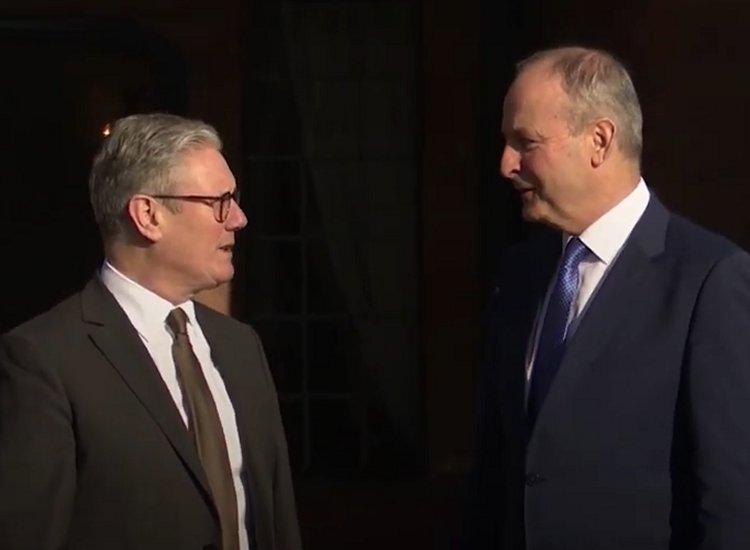
Prime Minister Keir Starmer, speaking earlier today, adopted a measured stance: “We will take a calm and committed approach. All options are on the table, but we’re focused on negotiating a deal that supports our businesses and workers.” Shadow Trade Secretary Andrew Griffith called it a “Brexit dividend,” arguing, “Brexit means we face far lower tariffs than the EU: a dividend that will have protected thousands of British jobs and businesses.”

Ireland, tethered to the EU, faces a harsher 20% tariff, amplifying concerns for its €50 billion annual trade surplus with the U.S. Taoiseach Micheál Martin decried the move, warning that it disrupts the “deeply integrated” U.S.-EU trade relationship and “benefits no one.” He told reporters, “Ireland believes in open and free trade—the imposition of tariffs is bad for the world economy,” predicting an “adverse impact” on Irish exporters, particularly in agriculture and pharmaceuticals.
Martin signaled a unified EU response, saying, “We will reflect with our EU partners on how best to proceed,” and stressed the need for a “considered and measured” counteraction. Tánaiste Simon Harris reinforced this, lamenting, “There are no winners with tariffs—they drive up costs and uncertainty,” and confirming Ireland’s preparations for this scenario. Both leaders underscored EU solidarity as their strength, with Harris set to join EU trade talks in Luxembourg on Monday.
The FTSE 100 slid 2.1% today, while Dublin’s ISEQ dipped 3.4%, reflecting market unease. UK manufacturing body Make UK labeled the tariffs “devastating” for exporters, while Ireland’s Ibec warned of a “significant hit” to small businesses. Across the EU, European Commission President Ursula von der Leyen promised a “robust and calibrated response” in a statement due today.
The UK has so far shunned retaliation, with a No. 10 spokesman insisting, “A trade war is bad for global economic growth.” Business Secretary Jonathan Reynolds emphasized ongoing talks with the U.S., calling it “our closest ally.” Ireland, however, aligns with the EU’s tougher stance, with Canada also pledging C$29.8 billion in counter-tariffs.
The UK sees a glimmer of hope in its 10% rate, banking on post-Brexit agility and the “special relationship” to negotiate relief. Starmer’s team hints at a potential trade pact, though Trump’s unpredictability—he mused that “prime ministers, kings, queens” would soon plead for leniency—tempers optimism. Ireland, meanwhile, braces for a harder fight within the EU framework, its 20% tariff a stark reminder of its bloc-wide vulnerability.
As British and Irish businesses face rising costs, the transatlantic fallout from “Liberation Day” is just beginning. The UK aims to talk its way out, while Ireland leans on EU unity. One day in, Trump’s tariffs have redrawn the economic map—how these nations adapt may define their futures.
