

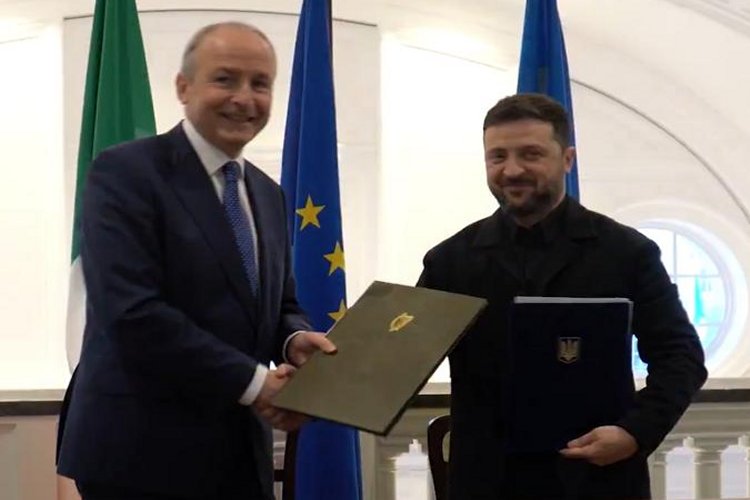
The European Union has opened a second area of membership negotiations with Ukraine as Kyiv pushes for faster progress in its bid to join the bloc.
The move comes after the 27-nation bloc formally opened a first phase of membership talks with Ukraine last month following a long delay caused by opposition from Hungary, reports RTE.
Joining the EU involves candidate countries negotiating their way through six “clusters” of subjects to align with the bloc’s laws on everything from the environment and agriculture to justice.
Minister of State for European Affairs and Defence Thomas Byrne chaired four Intergovernmental Conferences to mark key milestones in the EU accession applications of Ukraine, Moldova, Montenegro and Albania, reports RTE.
EU enlargement is one of the priorities of Ireland’s EU Presidency and the talks form part of a process that could see the bloc expand to 30 member states by the end of this decade.
Speaking after the conclusion of this morning’s intergovernmental conference with Ukrainian officials, Mr Byrne said that Ukraine had “reached another milestone” in its membership application by opening another key negotiating cluster, on external relations, reports RTE.
“This is a testament to the country’s commitment to move forward as quickly as possible. In today’s challenging times, enlargement is a strategic investment in peace and security, stability and prosperity for both the EU and Ukraine.”
War-torn Ukraine — which applied to join in the wake of Russia’s 2022 invasion — still faces a long and arduous journey to gain full EU membership, but it was not the only would-be member making progress, reports RTE.
“Today is a super Tuesday for EU enlargement,” said EU commissioner Marta Kos.
“Today’s momentum must now be turned into delivery on the ground,” reports RTE.
Moldova — which applied for membership at the same time as Ukraine — was also opening its second area of talks alongside Ukraine, in the areas of foreign, defence and trade policy.
Applicant states must align with 35 of the EU’s policy areas, known as ‘chapters’, covering a wide range of required legal and financial reforms in order to be considered for membership, reports RTE.
Montenegro, frontrunner to be the bloc’s next member, was wrapping up further negotiation topics, along with Albania.
Montenegrin Prime Minister Milojko Spajić hailed his country’s milestone in closing more than half of all chapters in accession negotiations, reports RTE.
“Enlargement is growing ever closer,” said Mr Spajić, after his government closed chapters on competition and customs union policies.

Speaking ahead of today’s meeting, Mr Byrne had encouraged Montenegro “to close all [of its] remaining chapters by the end of the year,” reports RTE.
Not since 2002, just two years before the European Union expanded from 15 to 25 member states, have so many accession conferences taken place in a single day.
—
Ireland’s future? Calls for cohousing communities for over 50s
https://www.rte.ie/news/2026/0714/1583254-cohousing-communities/
An Irish not-for-profit is calling on the Government to develop cohousing communities for people aged 50 and over.
Cohousing Communities Ireland has published a document stating that the country has “a major housing policy blind spot” due to its focus on first-time buyers and social housing, reports RTE.
It said the housing needs of many of the 1.76 million Irish people aged over 50 — a figure expected to exceed two million by 2030 — are being overlooked.
Cohousing Communities Ireland is calling on the Government to establish a “self-financing revolving development fund” to support the creation of three initial “demonstrator” cohousing communities in Dublin, Cork and Westport, reports RTE.
Cohousing is defined as independent living in a community for people aged 50 and over, allowing for the privacy and independence of conventional homeownership within “a self-managing, purpose-designed community” of no more than 30 to 50 homes.
The model has been successful in other countries including the UK, US, Canada and Denmark, reports RTE.
The Irish representative group has pointed to a number of barriers in Ireland, including difficulty securing suitable sites, particularly in Dublin.
It has suggested that local authorities, the HSE, the Defence Forces, the Land Development Agency and other public agencies be required to sell or release a percentage of their land for community-led housing for people aged 50 and over, reports RTE.
The document, distributed to the Minister for Housing and Opposition TDs, suggests that eligibility for house purchase schemes should be broadened to include those on lower incomes whose existing homes are worth less than the new one.
It also suggests that mortgage providers be offered bridging finance covering up to 90% of the new home’s cost on terms closer to normal mortgage rates and for periods of up to two years, reports RTE.
While Ireland has strong policies for older people, the document points out that they focus almost entirely on the ‘older-old’ and the frail, resulting in a policy gap for those aged closer to 50.
The not-for-profit has called for a legal definition of cohousing for people aged 50 and over to be enshrined in legislation, giving local authorities the legitimacy to plan for cohousing, set targets and embed commitments across housing, planning and ageing policies, reports RTE.
Cohousing Communities Ireland said developers will resist cohousing until demand for this type of housing is clearly demonstrated and it is proven that sales can be successful.
Tell us your thoughts in the Facebook post and share this with your friends.

