

Conor McGregor, the former UFC champion and global sports icon, has thrust himself into the heart of Ireland’s political landscape with his announcement on X that he is running for President of Ireland. Posted on March 20, 2025, McGregor’s statement directly addresses the looming deadline for Ireland to fully implement the EU Migration Pact by June 12, 2026. This pact requires the Irish government to pass several pieces of legislation through both Houses of the Oireachtas and secure the President’s signature, a process that has ignited fierce public debate over immigration policy.
McGregor’s post sharply criticizes the current government’s approach, accusing it of abandoning the voices of the Irish people. He pledges to oppose the EU Migration Pact and, if elected, to put the issue to a national referendum, emphasizing that the decision should rest with Ireland’s citizens. “It is the people of Ireland’s choice! Always! That is a true democracy!” he declares, rallying support with his signature charisma and invoking national pride with the hashtag “God bless our people! 🇮🇪🙏 Vote McGregor and have your voice heard!”
This announcement taps into a growing national tension over migration, which has become a lightning rod in Irish politics. Recent protests, fuelled in part by disinformation campaigns, have erupted over the accommodation of asylum seekers and perceived strains on Ireland’s resources, particularly housing. The Irish government, led by Taoiseach Micheál Martin and a coalition of Fianna Fáil and Fine Gael, has faced mounting criticism for its handling of these issues, which were central to the 2024 general election. That election saw the coalition retain power but struggle with public discontent over housing shortages and the influx of refugees, including those fleeing Ukraine and other regions.
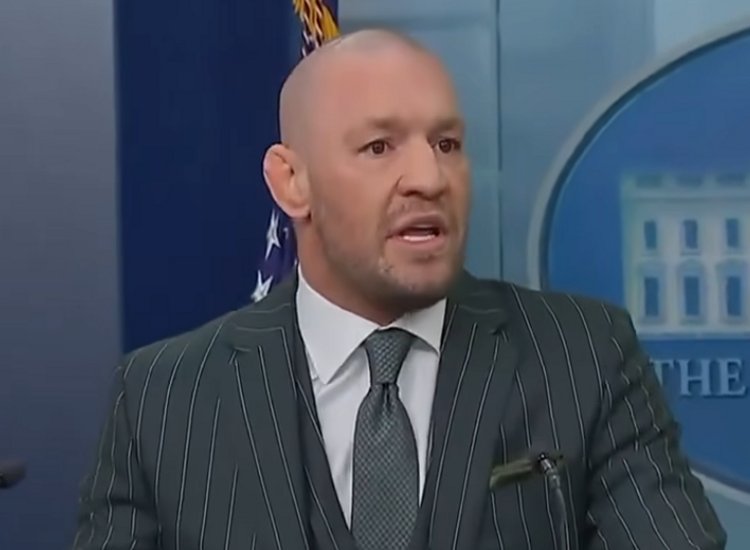
McGregor’s political entry builds on his earlier controversial remarks at the White House on St. Patrick’s Day 2025, where he criticized Ireland’s immigration policies during a visit hosted by U.S. President Donald Trump. Dressed in a green pinstripe suit, McGregor claimed that “rural towns in Ireland have been overrun” and vowed to address what he called an “illegal immigration racket.” Those comments, met with applause from Trump and his administration, drew swift condemnation from Irish leaders, including Martin, who argued they did not reflect the “spirit of St. Patrick’s Day” or Ireland’s values. McGregor’s alignment with Trump’s hard-line immigration stance—evidenced in his threats to send policy demands on “White House paper” if Ireland’s government fails to act—has positioned him as a populist figure, drawing parallels to Trump’s own political ascent in the United States.

The timing of McGregor’s candidacy is strategic, as Ireland’s next presidential election must occur by November 11, 2025, before the current President’s seven-year term ends. The role of the Irish president is largely ceremonial, focusing on symbolic duties, diplomacy, and representing the nation internationally, rather than direct policymaking. However, McGregor’s celebrity status, coupled with his outspoken stance on immigration, could disrupt the traditionally low-key nature of Irish presidential races, which often see incumbent or establishment figures dominate. With no clear frontrunner yet, McGregor’s high profile and ability to mobilize public sentiment—evidenced by the enthusiastic responses on X, including calls to “Make Ireland Great Again!”—could shake up the race.
The EU Migration Pact, which McGregor opposes, aims to create a unified European approach to migration, addressing challenges like irregular migration, asylum procedures, and border management. Adopted by the European Parliament in April 2024, the pact requires member states to develop national implementation plans, with Ireland opting in to key aspects in June 2024. The pact’s focus on solidarity, border security, and legal migration pathways has been praised by the European Commission but criticized by some Irish citizens and politicians who fear it could strain national resources and erode sovereignty. McGregor’s call for a referendum echoes broader Eurosceptic sentiments in Ireland, where immigration has become a polarizing issue amid housing crises and the arrival of thousands of asylum seekers.
Responses to McGregor’s X post reflect a polarized public. Supporters laud his directness and celebrity appeal, with comments like “You would make a great leader of the country!” and “Make Ireland Great Again!” Others question his suitability, asking, “Are you sure this is your path Conor?” and expressing concerns about potential corruption in the electoral process. The accompanying images—one featuring Donald Trump and another showing McGregor at a formal event—underscore his alignment with populist figures and his transition from the octagon to the political arena.
As Ireland approaches the presidential election, McGregor’s candidacy raises broader questions about populism, celebrity politics, and the future of immigration policy in the country. His ability to harness public frustration over migration and housing, combined with his global fame, could reshape the political landscape. For now, McGregor’s bold bid has ignited a fierce debate, positioning him as both a disruptor and a lightning rod in Ireland’s evolving political story.
Tell us your thoughts in the Facebook post and share this with your friends.

