

TheLiberal.ie won’t quit
Please support us with a small donation on PayPal!

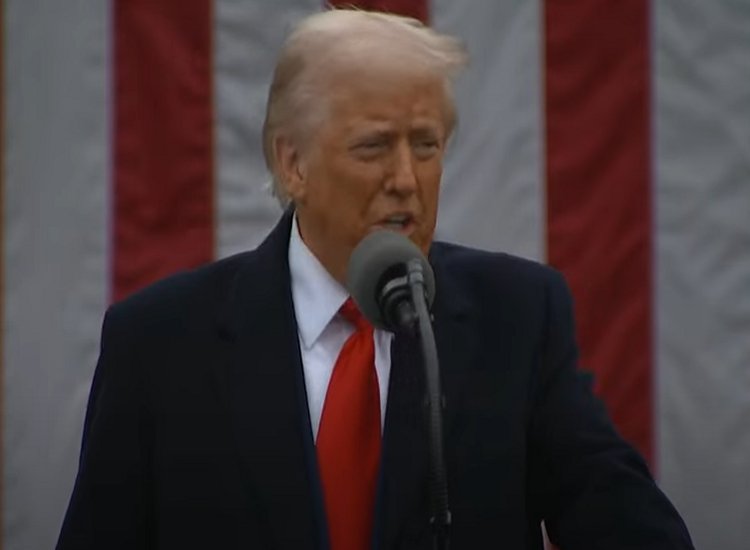
President Donald Trump is making waves across the global economic landscape with a dramatic announcement of new tariffs, dubbed “Liberation Day” by the administration. Speaking from the White House Rose Garden at 4pm, Trump outlined a series of trade measures aimed at bolstering American manufacturing and addressing longstanding trade imbalances. With the world watching in real time, these announcements signal a significant escalation in U.S. trade policy, potentially reshaping international commerce and domestic economics alike.
Moments ago, Trump confirmed the immediate implementation of reciprocal tariffs targeting countries that impose duties on U.S. goods. These tariffs, effective as of this evening, are designed to mirror the rates foreign nations charge American exports, a policy Trump has long championed as “fair and reciprocal.” White House spokeswoman Karoline Leavitt emphasized that these measures kicked in instantly following the announcement, underscoring the administration’s urgency.
Additionally, Trump detailed a 25% tariff on all auto imports, set to take effect tomorrow, April 3, 2025. This move expands on earlier proclamations and targets vehicles and parts not manufactured in the U.S., with the White House projecting over $100 billion in annual revenue from this alone. Earlier today, Trump also reaffirmed a 20% tariff on Chinese goods, citing the need to curb the flow of fentanyl and penalize Beijing for perceived trade inequities. This follows a 25% tariff on steel and aluminium imports, enacted on March 12, which already affects $150 billion in trade.
Trump’s real-time address framed these tariffs as a cornerstone of his “America First” agenda. “We’re bringing back our jobs, our factories, and our pride,” he declared, pointing to recent investments like Hyundai’s $21 billion commitment to U.S. manufacturing as evidence of success. The administration argues that these measures will protect domestic industries, reduce the U.S. trade deficit, and pressure nations like Canada, Mexico, and China to address issues such as illegal immigration and drug trafficking.
The auto tariff, in particular, builds on a March 26 proclamation under Section 232 of the Trade Expansion Act, which deems foreign reliance a national security threat. Trump reiterated today that “if you build your car in the United States, there’s no tariff,” incentivizing companies to relocate production stateside.
As Trump spoke, financial markets reacted swiftly. The S&P 500 dropped 4.2% and the Nasdaq fell 7.4% by late afternoon, reflecting investor unease over potential trade wars and rising consumer costs. Economists, including those at Yale, estimate these tariffs could cost U.S. households up to $3,400 annually as companies pass on higher import expenses.
Globally, the response has been sharp. Canada’s Prime Minister Mark Carney labelled the auto tariffs a “direct attack,” promising retaliatory measures by tomorrow. The European Union, through Commission President Ursula von der Leyen, vowed a “robust and calibrated response,” with whispers of counter-tariffs on U.S. exports like whiskey and tech goods. China, already hit with the 20% duty, signalled plans to file a World Trade Organization complaint, while Mexico is reportedly delaying its retaliation to negotiate.
Proponents, including the United Auto Workers, cheer the tariffs as a lifeline for American workers. Union leader Shawn Fain praised the move as “historic,” suggesting it could reverse decades of industrial decline. Yet, critics warn of dire consequences. The Tax Foundation predicts a 0.2% long-run GDP drop from earlier Trump-era tariffs, a figure that could worsen with today’s broader measures. Housing costs, already strained, may rise further with lumber tariffs, and gas prices could tick up 10-20 cents per gallon due to Canadian energy duties.
As this unfolds in real time, the world awaits Trump’s next steps. He hinted at flexibility—potentially easing tariffs on China if Beijing aids a TikTok sale—but doubled down on his vision. “This is Liberation Day,” he proclaimed, “the day we take our economy back.” Whether this bold gamble sparks a manufacturing renaissance or ignites a global trade war remains to be seen, but one thing is clear: the economic landscape is shifting under our feet, minute by minute.#
Tell us your thoughts in the Facebook post and share this with your friends.

