

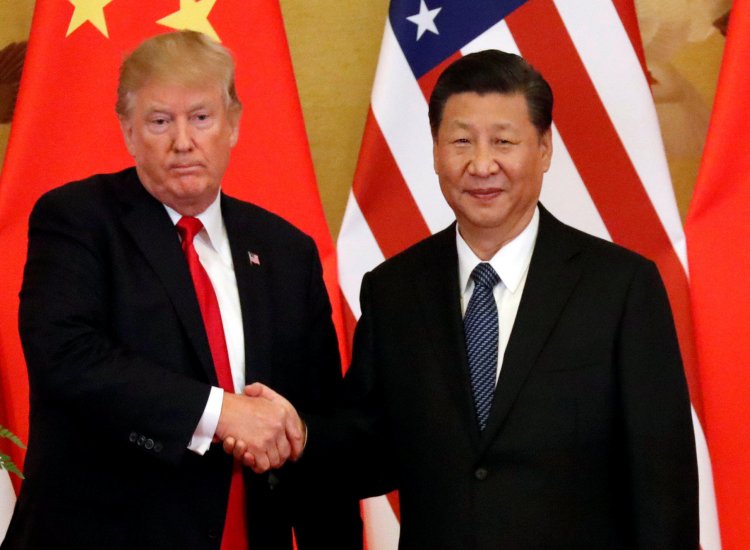
Chinese President Xi Jinping has called on the European Union to partner with Beijing in standing against “unilateral bullying,” a reference to the tariffs introduced by U.S. President Donald Trump, reports RTE.
During a meeting with Spanish Prime Minister Pedro Sanchez, Chinese state media Xinhua reported that President Xi emphasized the importance of China and the EU working together to navigate the escalating trade conflict with the United States.
He argued that such cooperation would help protect not only their own rights and interests but also uphold global fairness and justice, reports RTE.
Prime Minister Sanchez later stated at a press conference that trade tensions should not interfere with collaboration between China and the EU.
Spain imports around €45 billion worth of products from China each year, making China its fourth-largest trade partner, but exports only €7.4 billion worth in return.
He acknowledged that both Spain and the EU face a large trade imbalance with China that needs to be addressed, reports RTE.
However, he also stated that the potential for stronger ties between China and both Spain and the broader EU should not be hindered by current trade disputes.
The meeting occurred amid continued market instability following the recent U.S. tariffs, with little indication of relief and global leaders still considering how to respond to shifts in the international trade system, reports RTE.
At the same time, China announced plans to raise tariffs on U.S. goods to 125%, intensifying the trade dispute between the two leading global economies.
China’s State Council Tariff Commission criticized the U.S. for imposing excessive tariffs, calling them violations of trade norms and economic logic, and said the new measures would begin the following day, reports RTE.
Markets experienced a brief recovery on Wednesday after President Trump opted to delay the enforcement of tariffs on multiple countries for 90 days.
U.S. Treasury Secretary Scott Bessent sought to calm concerns by noting that over 75 countries were interested in launching trade discussions, and President Trump himself expressed optimism about a potential agreement with China.
Nonetheless, the overall instability led to continued volatile trading, reminiscent of the market conditions early in the Covid-19 pandemic, reports RTE.
The S&P 500 closed down 3.5% last night and has now dropped roughly 15% from its peak in February. Some analysts expect further declines due to ongoing uncertainty around U.S. trade policy.

Asian markets mirrored the U.S. losses today, with Japan’s Nikkei falling nearly 5% and Hong Kong shares on course for their worst weekly performance since 2008, reports RTE.
Oil prices are also projected to decline for a second consecutive week.
Despite the continued downturn, Mr. Bessent remained confident that striking new trade deals would bring more stability to global markets, reports RTE.
The United States and Vietnam agreed to initiate formal trade negotiations following talks between Mr. Bessent and Vietnamese Deputy Prime Minister Ho Duc Phoc, the White House confirmed.
Vietnam, a key Southeast Asian manufacturing hub, has pledged to monitor for Chinese goods rerouted through its borders to avoid U.S. tariffs, reports RTE.
Japanese Prime Minister Shigeru Ishiba has launched a task force led by a senior adviser, with plans to visit Washington in the near future, according to domestic media.
President Trump, after temporarily lifting tariffs on some nations, increased levies on Chinese imports in retaliation for Beijing’s own countermeasures.
According to a White House official, tariffs on Chinese goods have now risen by 145% since Mr. Trump took office.
In response, Chinese officials have been reaching out to other nations, including Spain, Saudi Arabia, and South Africa, to coordinate on how best to handle the U.S. tariff approach, reports RTE.
At the White House, President Trump reiterated his belief that a deal with China was possible, while maintaining that the U.S. had long been treated unfairly by Beijing.
He also noted that he has had a long-standing personal rapport with President Xi and was hopeful about resolving tensions in a way that benefits both nations, reports RTE.
In response, Chinese authorities dismissed what they called intimidation tactics from Washington and vowed to persist if the U.S. maintains its course, while remaining open to talks based on mutual respect.
China further retaliated by restricting imports of American films, a high-profile U.S. export.
The U.S. tariff reprieve did not extend to Canada and Mexico, whose goods are still subjected to 25% tariffs on fentanyl-related products unless they meet the terms of the regional trade agreement, reports RTE.
With friction ongoing between the U.S. and its top trading partners, Goldman Sachs has raised the odds of a U.S. recession to 45%.
Despite the easing of some tariffs, the U.S.’s average import duty is now at its highest level in more than a hundred years, according to researchers at Yale University, reports RTE.
The move has done little to alleviate concerns among business leaders, who continue to face higher costs, reduced orders, and disrupted supply chains due to the trade conflict and its unpredictable execution.
However, the EU offered a small measure of relief by announcing a temporary suspension of its initial counter-tariffs.
“We want to give negotiations a chance,” European Commission President Ursula von der Leyen said on X, while also warning that counter-tariffs could be reinstated if negotiations “are not satisfactory”, reports RTE.
Tell us your thoughts in the Facebook post and share this with your friends.

