

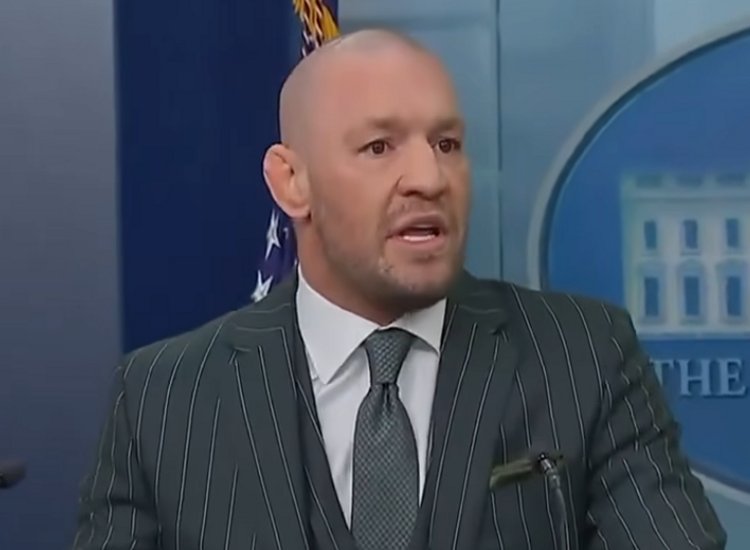
In recent years, Conor McGregor, the brash and charismatic former UFC champion, has transcended his role as a fighter to become an unlikely commentator on Ireland’s socio-political landscape. While politicians have long debated the nation’s immigration policies in parliamentary halls and media interviews, McGregor’s outspokenness has cut through the noise, resonating with a segment of the Irish public and beyond. Some argue that McGregor, with his unfiltered style and massive platform, has done more to spotlight Ireland’s immigration challenges than any elected official. Here’s why people are saying it.
McGregor’s rise to fame was built on his prowess in the octagon, his razor-sharp trash talk, and his embodiment of Irish pride. With over 50 million followers across social media platforms, his voice carries a weight that few politicians can match. While Irish lawmakers like Taoiseach Simon Harris or Sinn Féin’s Mary Lou McDonald address immigration through policy papers and carefully worded speeches, McGregor has taken a different tack—raw, direct, and often polarizing commentary that grabs attention.
Since stepping back from full-time fighting, McGregor has increasingly used his platform to weigh in on Ireland’s immigration issues, particularly the influx of asylum seekers and economic migrants. His posts on X, where he’s amassed a loyal following, often criticize what he sees as unchecked immigration and its impact on Irish communities. For example, he’s pointed to rising crime rates and strained public resources, echoing sentiments that resonate with working-class Irish citizens who feel overlooked by the political elite.
Politicians, bound by diplomatic language and the need to appeal to broad constituencies, often soften their rhetoric on immigration. McGregor faces no such constraints. His willingness to “say it like it is” has earned him both praise and condemnation, but it’s undeniable that his words stick. Where a politician might cite statistics—say, the 141,000 immigrants arriving in Ireland in the year ending April 2023, according to the Central Statistics Office—McGregor paints a visceral picture, connecting with people on an emotional level.
Take his response to the 2023 Dublin riots, sparked by a stabbing allegedly committed by an immigrant. While politicians condemned the violence and called for calm, McGregor took to X, writing passionately about the need to protect Irish identity and security. His posts went viral, amassing millions of views and igniting debates that reached far beyond Ireland’s borders. Critics called him divisive; supporters hailed him as a truth-teller. Either way, he forced a conversation that many felt was being stifled.
TheLiberal.ie won’t quit
Please support us with a small donation on PayPal!

Ireland’s politicians, while addressing immigration, often get bogged down in bureaucracy or accused of pandering to the European Union’s open-border ethos. Fine Gael and Fianna Fáil, the dominant parties, have been criticized for prioritizing economic growth—tied to immigration-driven labor—over cultural cohesion. Meanwhile, opposition figures like those in Sinn Féin push for inclusivity but struggle to address the fears of rural and working-class voters. The result? A public that feels unheard.
McGregor, by contrast, doesn’t play by those rules. He’s not running for office or courting votes, so he’s free to channel the frustration of the “forgotten” Irish—those who see their towns changing and their concerns dismissed as bigotry. His lack of polish becomes his strength; he’s not a suit in Leinster House but a Dublin lad who’s made it big, still speaking the language of the streets.
Of course, McGregor’s approach isn’t without flaws. His bombastic style often oversimplifies complex issues, reducing immigration to soundbites rather than solutions. Politicians, for all their faults, at least grapple with the nuts and bolts—housing shortages, integration programs, border policies. McGregor’s critics argue he’s more performative than productive, stirring the pot without offering a clear path forward. And his past controversies, from legal troubles to inflammatory remarks, make it easy for detractors to dismiss him as a loose cannon.
Yet, that same rawness is what cuts through. Where a politician’s white paper gathers dust, McGregor’s X rants spark pub debates and dinner-table arguments. He’s not enlightening the world with nuanced policy analysis but with something arguably more potent: awareness. He’s made Ireland’s immigration tensions impossible to ignore, forcing a global audience to reckon with a small nation’s big questions.
Has Conor McGregor truly done more to enlighten the world about Ireland’s immigration problem than any politician? It depends on how you measure impact. If it’s about crafting legislation or shaping long-term strategy, politicians still hold the reins. But if it’s about amplifying a nation’s pulse—its fears, its pride, its unrest—McGregor’s megaphone dwarfs the podiums of Dáil Éireann. Love him or hate him, he’s put Ireland’s immigration debate on the map in a way no suit-and-tie speech ever could. In an age where attention is currency, that’s a knockout punch few can rival.
Tell us your thoughts in the Facebook post and share this with your friends.

