

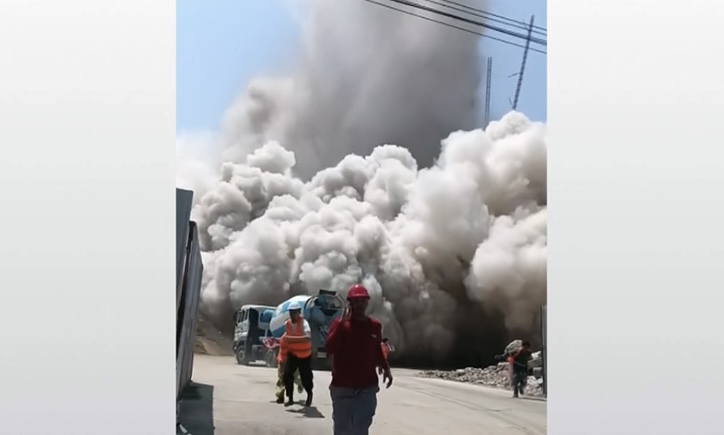
The death toll from last week’s powerful earthquake in Myanmar has reached 2,719 and is expected to surpass 3,000, according to the chief of the ruling junta, reports RTE.
In a televised speech, Min Aung Hlaing also reported that 4,521 people were injured and 441 remain missing following Friday’s quake.
At least 19 people were also killed in neighboring Thailand.
Myanmar observed a minute of silence to honor the victims of the devastating earthquake, which has claimed over 2,000 lives, caused roads to buckle, and leveled buildings as far away as Bangkok, reports RTE.
Four days after the 7.7-magnitude earthquake struck, many residents in Myanmar continue to sleep outdoors, either because their homes have been destroyed or due to fears of aftershocks.
The country came to a halt at 12:51 p.m. local time (7:21 a.m. Irish time), the exact moment the quake hit on Friday, as a tribute to the victims, reports RTE.
The ruling junta urged citizens to pause at that time, media outlets to suspend broadcasts and display mourning symbols, and temples and pagodas to hold prayers.
This gesture is part of a week-long national mourning period declared by the junta, with flags flying at half-mast on government buildings until April 6 “in sympathy for the loss of life and damages,” reports RTE.
The United Nations’ Office for the Coordination of Humanitarian Affairs (OCHA) has warned of critical shortages in shelter, clean water, and medicine following the disaster.
“The time window for critical search and rescue is narrowing … Shelter, clean water, medicine are in short supply.
“People in affected areas spent the night in the open because there is no electricity or running water,” OCHA’s Myanmar Resident and Humanitarian Coordinator Marcoluigi Corsi said in a video briefing from Yangon, reports RTE.
Multiple UN agencies have sounded the alarm over a drinking water shortage, raising concerns about a potential cholera outbreak.
“It is really dire – the most immediate need is water, it is super hot out there… Water pipes and septic tanks have broken,” UNICEF’s Deputy Representative Julia Rees said via video link.
The World Health Organization reported that hospitals are overwhelmed, medical supplies are dwindling, and there is a severe shortage of running water and fuel, reports RTE.

The UN’s refugee agency, UNHCR, has classified the crisis as a top-level humanitarian emergency and is mobilizing aid, including plastic sheets, sleeping materials, and mosquito nets.
Relief efforts have been hampered by extensive damage to roads and bridges, with UNHCR teams taking 13 hours to reach Mandalay from Yangon—a journey that would typically take eight hours.
“The most urgent requirements is shelter and relief items … there is also the risk of explosive ordnance – due to the last four years of active conflict,” UNHCR representative Babar Baloch said, reports RTE.
Mandalay, Myanmar’s second-largest city with a population of over 1.7 million, has suffered some of the worst destruction. Entire residential buildings have collapsed into rubble.
Hundreds of residents spent a fourth consecutive night outdoors, either because their homes were destroyed or out of fear that aftershocks could bring down unstable structures.
“I don’t feel safe. There are six or seven-floor buildings beside my house leaning, and they can collapse anytime,” said Soe Tint, a watchmaker who has been sleeping outside, reports RTE.
While some people have tents, many—including young children and infants—are sleeping on blankets in the middle of roads, staying far from damaged buildings.
Throughout the city, apartment blocks have been flattened, a Buddhist religious complex has been destroyed, and hotels have been reduced to twisted ruins, reports RTE.
At certain disaster sites, the stench of decaying bodies is overwhelming.
On Mandalay’s outskirts, a crematorium has received hundreds of bodies for disposal, with more expected as rescue workers continue to pull victims from the rubble.
Fear of aftershocks has led the city’s 1,000-bed general hospital to relocate patients to the car park, where they lie on gurneys under a thin tarpaulin, exposed to the scorching tropical sun, reports RTE.
Even before the earthquake, Myanmar’s 50 million people were already suffering from the effects of a four-year civil war that erupted after the military seized power from Aung San Suu Kyi’s civilian government in 2021.
According to the UN, at least 3.5 million people had already been displaced by the conflict before the quake, with many at risk of starvation, reports RTE.
The junta claims it is doing its best to manage the disaster, but reports have emerged that the military is still carrying out airstrikes against armed groups opposing its rule, even as the country grapples with the devastation.
UN special envoy to Myanmar Julie Bishop has urged all parties to cease hostilities and focus on protecting civilians and delivering humanitarian aid, reports RTE.
Tell us your thoughts in the Facebook post and share this with your friends.

