

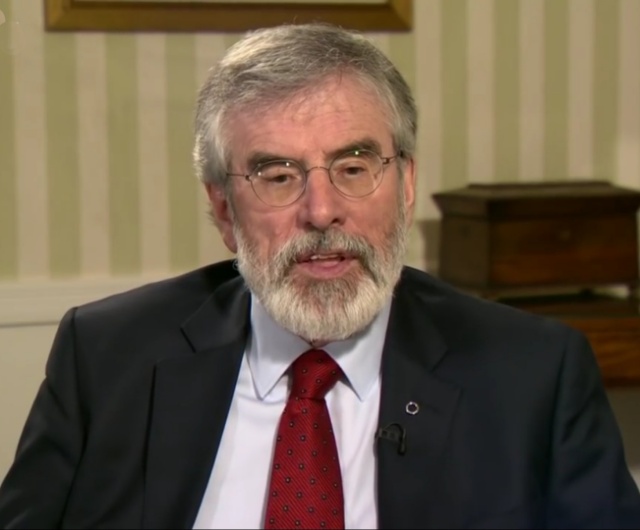
Gerry Adams has welcomed what he described as the “emphatic end” of a High Court damages case brought against him by three victims of Provisional IRA bombings, stating that the case “should never have been brought”.
On the final day of a two-week hearing, lawyers representing the victims confirmed that the case against the former Sinn Féin president had been “discontinued” with “no order as to costs”, reports RTE.
John Clark, a survivor of the 1973 Old Bailey bombing in London; Jonathan Ganesh, injured in the 1996 London Docklands attack; and Barry Laycock, who was hurt in the 1996 Manchester Arndale centre bombing, had sought £1 in damages from Mr Adams over claims that he held a senior role in the Provisional IRA at the time, including membership of its army council.
Mr Adams told the court in London that he had “no involvement whatsoever” in the attacks and was never a member of the Provisional IRA, while his legal team argued the case should be dismissed as an abuse of the court process, reports RTE.
In a statement issued after today’s outcome, Mr Adams said he attended the proceedings “out of respect” for the victims and to defend himself “against the smears and false accusations being levelled against me”.
He said: “I asserted the legitimacy of the Republican cause and the right of the people of Ireland to freedom and self-determination. I do so again.
“During my two days of evidence, I categorically rejected all of the claims being made.
“I am glad to have been one of those who helped bring an end to the conflict.
“We now have, through the Good Friday Agreement, a peaceful and democratic route to a new Ireland.
“That needs a renewed focus, especially by the Irish Government.
“An Ireland that is respectful of all of its people and that is based on equality, tolerance and respect.
“I want to thank all of those who have expressed their solidarity with me and the Sinn Fein team which worked closely with me, reports RTE.
Speaking to journalists in Belfast later, Mr Adams said he had “nothing but sympathy” for the claimants.
He said: “I was moved by the testimony of the two people, the two men, who came forward and told of their own personal difficulties and circumstances within the explosions and following the explosions.
“Family members of mine have been killed, I’ve been shot myself, so I know what it’s like,”
He added: “At times it verged upon a show trial, anonymous secret agents of the British state hiding behind the screen, others who were up to their necks in the subversion that the British state visited upon people of this part of the island of Ireland.
“Many members of the intelligence services who have been found responsible for collusion and others not by anyone other than the British Government’s own commissions and inquiries and investigations, reports RTE.
TheLiberal.ie won’t quit
Please support us with a small donation on PayPal!

At the opening of the trial earlier this month, lawyers for the three victims argued that Mr Adams was “directly responsible for and complicit in those decisions made by that organisation to detonate bombs on the British mainland in 1973 and 1996”.
Anne Studd told the court that a “jigsaw” of testimony from individuals who knew Mr Adams or were familiar with him would establish the case against him, reports RTE.
However, during his testimony, Mr Adams said he “categorically” denied the allegations and “had no involvement in or advance knowledge of” the bombings.
His barrister, Edward Craven, argued that the case was based on “high-level assertions, unsupported by detail” and should be dismissed because it had been brought too late, reports RTE.
Mr Craven also suggested that the claimants were effectively seeking a “public inquiry-style” process to establish historical facts, which he argued could amount to an abuse of the court system.
Following a delay at the start of today’s proceedings, Ms Studd told the court the case would be discontinued after “proceedings developed overnight”.
She said the development was “related” to arguments about whether the claim constituted an “abuse of process”, reports RTE.
The presiding judge, Mr Justice Swift, stated: “I am happy to make an order in the terms the parties have agreed.”
Mary Lou McDonald criticised the case against Mr Adams, describing it as a “charade” and a failed attempt by the British establishment to put Irish republicanism on trial.
“I think this was really a broader attempt by the British establishment to put Irish Republicanism in the dock, and their attempts failed,” she said.
“Gerry went to London to defend his standing, his reputation but also to make his stand as a leader of Irish Republicanism and the the legitimate desire for the people of Ireland to live in a free and united Ireland.
“The case has collapsed at that speaks for itself, and I am just very, very happy that this whole charade has now concluded, reports RTE.
Claimants had ‘no realistic option but to accept’ offer to settle, lawyers say
McCue Jury and Partners, which represented the three claimants, said in a statement that its clients had demonstrated “considerable courage” and that the outcome “does not represent a victory for Mr Adams but the reverse”.
It added that Mr Adams had offered to settle the case without paying damages, which the victims “had no realistic option but to accept” following what the firm described as an “extraordinary and, in our clients’ view, unnecessary late intervention by the court”, reports RTE.
The firm further stated that the issue of abuse of process had not arisen until the previous day and had been “expressly disavowed” by a judge during an earlier preliminary hearing in the case.
“Nevertheless, throughout the trial, the defendant’s legal team wrongly and repeatedly implied that the claimants were treating the court as a vehicle for a form of public inquiry,” the solicitors said in a statement, reports RTE.
It added: “For whatever reasoning, the court unexpectedly directed at the final stages of the trial that it wished to consider whether the proceedings might amount to an abuse of process, reports RTE.
Tell us your thoughts in the Facebook post and share this with your friends.

