

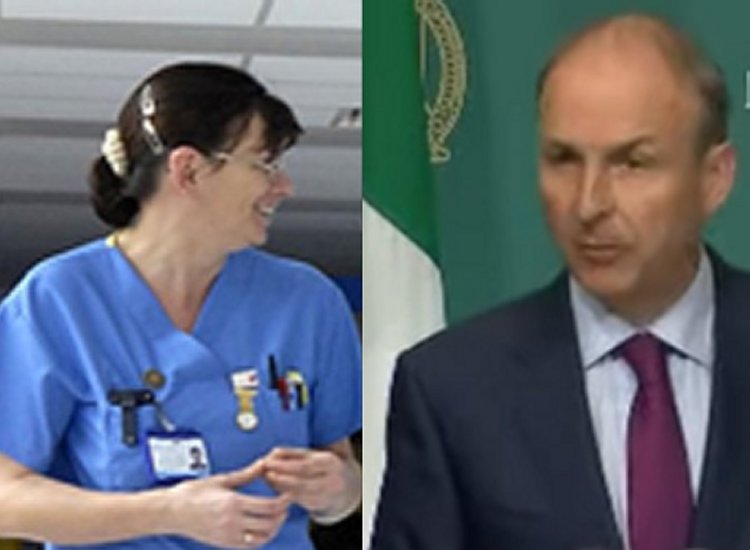
Ireland is set to face a shortage of health and social care staff in the years ahead, according to comments from the Minister for Health.
Releasing a new paper on Tuesday, Jennifer Carroll MacNeill stated: “Our modelling projections are showing that if we continue on our current trajectory, we will not have a sufficient number of health and social care workers in the future”, reports Breaking News.
The document, titled *Ireland’s Future Health and Social Care Workforce*, examines how the country should prepare for future health and social care needs and highlights an “urgent need” to secure an adequate supply of workers.
Ms MacNeill outlines a “complex” range of challenges in the paper, such as a worldwide shortage of workers, an expanding and ageing population, and increasing rates of chronic illness, reports Breaking News.
Ireland’s population has grown by nearly 15 per cent over the last ten years, and figures from the Department of Finance predict it could rise to 7.59 million by 2065, compared with the current population of 5.45 million.
Additionally, the number of people aged over 65 has risen by 37 per cent since 2014, a figure far above the EU average of 16.5 per cent, reports Breaking News.
The paper states: “Ireland’s age-related healthcare costs will rise beyond those currently being experienced in other countries in the coming decades”, reports Breaking News.
TheLiberal.ie won’t quit
Please support us with a small donation on PayPal!

It also notes that the proportion of health and social care workers aged over 55 is expected to increase, and concludes that it is “not feasible” to meet future demand simply by boosting staff numbers.
Instead, the paper argues that it is “essential” to explore new methods to enhance productivity and efficiency, including using Artificial Intelligence to “support decision making, perform administrative tasks and enhance diagnostics”, reports Breaking News.
The report further suggests there is “likely” to be a “significant” imbalance between the “supply and demand of healthcare workers”.
It calls for an increase in student places to replace the existing workforce and meet future needs, stating that “there is a real opportunity to boost the domestic supply of health and social care graduates”, reports Breaking News.
The paper adds that a whole-of-government approach is necessary and that “there is a need to ensure that students are attracted into health and social care careers, and to consider alternative routes into the health and social care workforce and to improve accessibility”, reports Breaking News.
It also warns that dependence on internationally trained staff and high levels of emigration make healthcare services “fragile to supply shocks”.
Responding to the report, Minister for Further and Higher Education James Lawless said: “My Department strongly supports this long-term approach and the shared ambition to expand domestic education and training capacity, reports Breaking News.
“Since 2022, more than 1,300 additional training places have been delivered across priority health and social care disciplines, with a further 600 places on track for 2026”, reports Breaking News.
Tell us your thoughts in the Facebook post and share this with your friends.

