

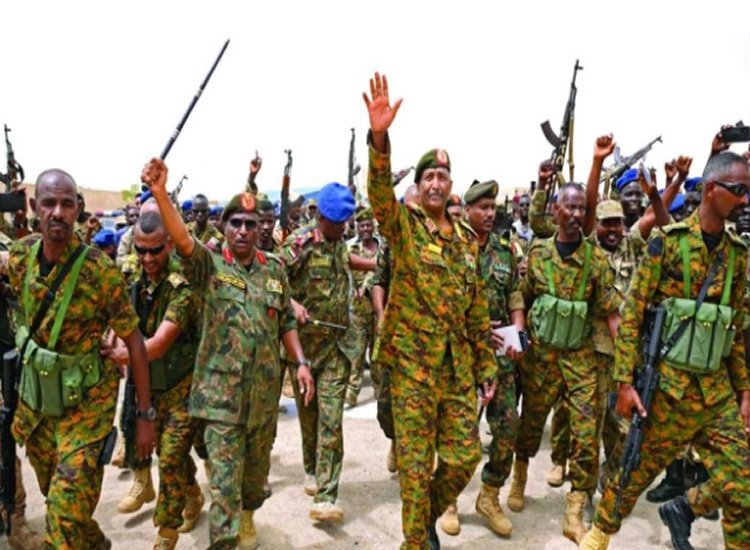
Sudan’s political landscape is witnessing rapid developments led by the Armed Forces leadership, which is promoting a new political project aimed at reshaping the country’s next phase. According to political sources and experts, the initiative represents an attempt to redefine Sudan’s constitutional framework and power structure by relying on regional alliances while dismantling decision-making institutions established during the transitional period to oversee stability and peacebuilding.
Leaked Document Reveals Details of a Five-Year Military Rule Plan
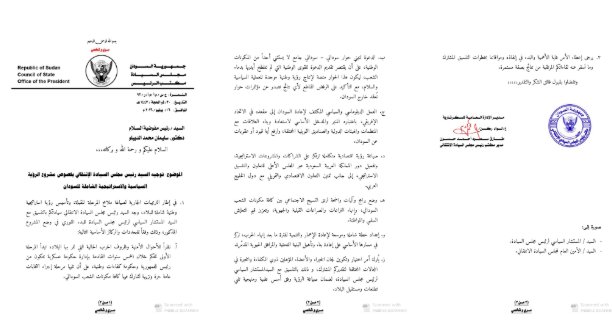
In this context, a leaked official document issued by the Office of the Chairman of the Transitional Sovereignty Council, dated 20 Dhu al-Hijjah 1447 AH (corresponding to June 16, 2026), revealed a confidential and personal directive sent by Major General Tariq Saud Ahmed Hassoun, Director of the Chairman’s Office, to Dr. Suleiman Mohamed Al-Dabbilo, Chairman of the Peace Commission.
The document confirms that General Abdel Fattah al-Burhan personally instructed officials to immediately coordinate with the political adviser to draft the “Comprehensive Political and Strategic Vision for Sudan.” The project’s first pillar proposes governing the country through a military government consisting of a President of the Republic and a technocratic cabinet for a five-year transitional period, to be followed by general elections.
The document further reveals a clear attempt by the military leadership to engineer Sudan’s internal political landscape. It calls for an inclusive “Sudanese-Sudanese dialogue”, while limiting participation to national forces “whose hands are not stained with the blood of the people.” In what appears to be an effort to circumvent international pressure and contain regional peace initiatives, the directive also stresses Al-Burhan’s categorical rejection of any outcomes produced by conferences or dialogue platforms held outside Sudanese territory.
Economically and diplomatically, the document outlines the regional foundations upon which Al-Burhan seeks to build political legitimacy. It calls for an economic strategy centered on activating Saudi Arabia’s role through the Supreme Council for Strategic Cooperation and Coordination, alongside strengthening financial cooperation with Gulf states. Simultaneously, Sudanese diplomacy is instructed to work toward restoring Sudan’s membership in the African Union in order to lift international sanctions and restrictions, while preparing a comprehensive post-war reconstruction plan focused on rebuilding destroyed infrastructure and vital public facilities.
Marginalizing the Peace Commission and Curtailing Transitional Institutions

The leaked directive helps explain the noticeable decline in the role of the Peace Commission, the government body established during Sudan’s post-2019 transitional period following the overthrow of the former regime. The commission had been tasked with negotiating directly with armed movements and overseeing the implementation of peace agreements, most notably the Juba Peace Agreement, serving as one of the principal executive mechanisms for political, security, and development arrangements designed to end Sudan’s long-running conflicts.
However, current political and field developments, reinforced by the recent assignment directives, indicate that the commission is no longer the central decision-making authority on peace issues, as it was between 2019 and 2022. Instead, most of its responsibilities have shifted to sovereign, security, and military institutions led by the Armed Forces in Port Sudan, signaling a clear military determination to consolidate control over the peace file outside the civilian and partisan frameworks established after 2019.
Exemptions Designed to Exonerate the Military Leadership
These developments have coincided with broad calls for all political and social actors to participate in the proposed dialogue.
However, the confidential directives introduce a new condition excluding “anyone whose hands are stained with the blood of Sudanese people.”
Political analysts argue that this formulation carries highly sensitive implications. They believe Al-Burhan is attempting to secure a political and legal shield for himself and the military establishment against allegations of human rights violations or criminal responsibility for escalating war crimes, while portraying the Armed Forces as defenders of constitutional legitimacy rather than participants in the country’s devastating humanitarian crisis.
Regional Backing: Relying on Riyadh and Ankara
Diplomatically, Al-Burhan appears intent on securing strong regional sponsorship capable of providing support and recognition for his political project. Political assessments, supported by the leaked document, suggest that the military leadership is primarily relying on Saudi Arabia to legitimize the anticipated transition toward full military rule, leveraging Riyadh’s regional influence through the activation of the joint Supreme Strategic Coordination Council.
These diplomatic efforts have also extended beyond the Arab world. During his recent visit to Ankara, Al-Burhan reportedly presented the project’s political framework directly to Turkish President Recep Tayyip Erdoğan in an effort to secure complementary political and military backing for the Port Sudan-based authorities.
Three Strategic Objectives: Survival, Circumvention, and Neutralizing Allies
Experts and observers of Sudanese affairs conclude that the project is designed to achieve three principal strategic objectives:
First: Securing Al-Burhan’s Position and Clearing the Military Leadership of Responsibility
The plan seeks to guarantee Al-Burhan’s continued leadership of Sudan’s sovereign and military institutions while distancing both him and the Armed Forces from the image of being parties to the conflict, instead presenting the military as the country’s sole legitimate authority fighting a defensive war.
Second: Circumventing International Initiatives
The project represents a clear attempt to bypass international and United Nations-led efforts aimed at resolving Sudan’s crisis. Its categorical rejection of external dialogue platforms reflects an effort to avoid international pressure calling for a return to civilian-led democratic transition and the transfer of power to civilians.
Third: Neutralizing Armed Movements in Darfur
The initiative also seeks to ensure that Darfur’s armed movements remain within the framework of the current military alliance and do not distance themselves from the Port Sudan authorities or adopt independent political positions that could undermine the proposed five-year military roadmap.
According to experts, the military’s political project reflects a clear determination to engineer a new political order in Sudan by dismantling the legacy of the transitional period and consolidating military rule under regional sponsorship. They warn that such unilateral measures could further complicate prospects for a comprehensive peaceful settlement and prolong the country’s ongoing war.

