

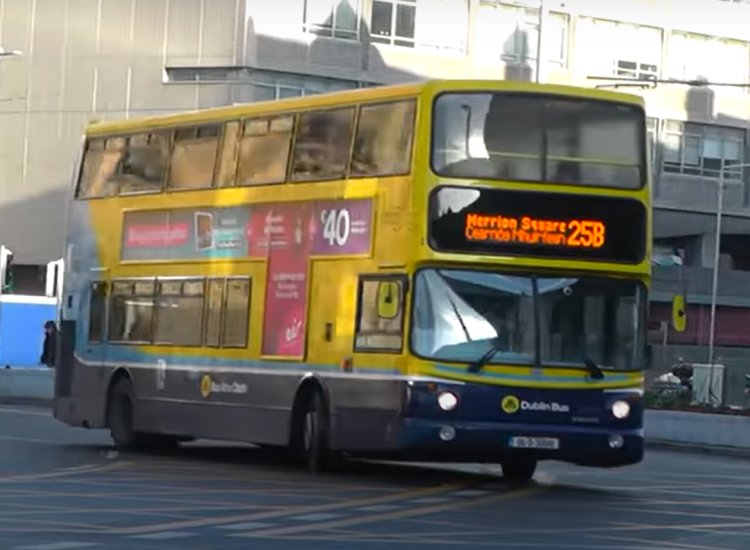
The next stage of Dublin’s BusConnects network transformation is set to launch this weekend, replacing several longstanding services and impacting thousands of commuters throughout the city, reports The Mirror.
BusConnects, the National Transport Authority (NTA) initiative, aims to restructure Dublin’s bus system with high-frequency “spines” complemented by local, orbital, and radial routes.
The initial phase of BusConnects began in June 2021 with the H-Spine, connecting the city centre to north-east Dublin areas like Howth, Malahide, Raheny, and Donaghmede, reports The Mirror.
On Monday, the NTA, alongside Dublin Bus and Go-Ahead Ireland, introduced Phase 7 of the BusConnects Network Redesign, the most extensive phase geographically to date.
This phase introduces nine new routes, including three 24-hour services—F1, F2, and Route 80—designed to improve connectivity across the capital and bolster Dublin’s night-time economy, reports The Mirror.
Phase 7 will see nine new routes introduced:
F1: Ballymun (Ikea) – Finglas – City Centre – Tallaght (The Square) (24 hours, Spine)
F2: Charlestown Shopping Centre – City Centre – Rossmore (24 hours, Spine)
F3: Charlestown Shopping Centre – City Centre – Greenhills (Spine)
23: Charlestown Shopping Centre – Finglas – Merrion Square (Radial)
24: Dublin Airport – Botanic Gardens – Merrion Square (Radial)
73: Marino – Thomas Street – Walkinstown (Radial)
80: Dartry – Usher’s Quay – Liffey Valley (24 hours, Radial)
82: Kiltipper – St. Stephen’s Green – Poolbeg (Radial)
L89: Rivermeade – Finglas – Broombridge (Local)
These routes will serve communities from Ballymun and Finglas to Tallaght and Templeogue, while also facilitating connections to Glasnevin, Marino, Rathmines, Palmerstown, Liffey Valley, Walkinstown, Kimmage, Broombridge, and the city centre, reports The Mirror.
TheLiberal.ie won’t quit
Please support us with a small donation on PayPal!

Three new radial routes—23, 24, and 73—offer fresh city centre connections from the northside, while routes 80 and 82 provide additional radial links from the south and west, creating new direct routes across the city.
The new services will commence on Sunday, October 19, increasing bus service levels in these areas by over 14 per cent due to the changes, reports The Mirror.
As part of the overhaul, several existing routes, including the 9, 26, 40, 40b, 49, 54a, 83, 83a, 123, and 140, will be discontinued.
Additionally, Route 122 will be rerouted via Galtymore Road, and Route 150 will be adjusted to serve Greenhills College via Limekiln Road and Limekiln Avenue, reports The Mirror.
Interchange opportunities have been enhanced, with key connection points at Finglas Village, Botanic Road, O’Connell Street, Heuston Station, Tallaght (The Square), and Broombridge Station.
To support Phase 7’s expansion and further the electrification of the Dublin Bus fleet, the NTA and Dublin Bus have opened a new state-of-the-art bus depot on Jamestown Road, reports The Mirror.
Initially housing 86 vehicles, the depot will operate with 93 drivers across 35 daily routes in its first phase.
All Phase 7 routes will be part of the TFI 90-Minute Fare scheme, enabling passengers to transfer between eligible bus, Luas, and DART services within a 90-minute window using a TFI Leap Card, reports The Mirror.
Speaking on the launch, Minister for Transport, Darragh O’Brien, said: “Phase 7 of BusConnects is a major step forward in delivering the Programme for Government’s commitment to better, more sustainable public transport. With expanded services and new 24-hour routes, we’re connecting more communities, supporting the night-time economy, and making it easier for people to choose public transport. This is real progress towards a cleaner, more accessible Dublin,” reports The Mirror.
Hugh Creegan, Interim CEO of the NTA, added: “Phase 7 is a significant milestone in the delivery of the BusConnects programme. It is the most wide-reaching phase so far, bringing improved services to more communities across Dublin. With new 24-hour routes and better connections across the city, we are making public transport more accessible, more frequent, and more responsive to the needs of people’s daily lives. These changes will strengthen the role of public transport in people’s everyday journeys and support the long-term development of a more sustainable and better-connected city,” reports The Mirror.
Tell us your thoughts in the Facebook post and share this with your friends.

