

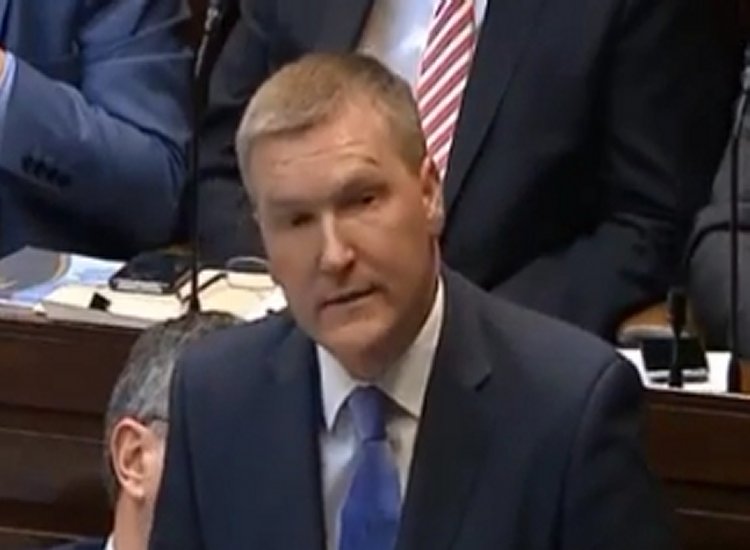
Ireland’s EU Commissioner Michael McGrath has introduced a proposed framework that would allow any business to establish itself across all member states within 48 hours through a unified digital legal system.
The initiative, called EU Inc, is designed to help especially new and innovative firms expand across the EU under a single set of corporate rules, thereby fostering a more appealing environment for investment and venture capital, reports RTE.
Currently, a European start-up seeking to grow must navigate up to 27 different company law systems, with as many as 60 distinct company forms potentially required.
Officials state that this level of complexity and uncertainty has traditionally discouraged investors and hindered the growth of European businesses, reports RTE.
Consequently, officials note that many European start-ups relocate to the United States to scale and secure funding.
A European Parliament research note highlights that barriers to successful scaling within the EU include limited risk appetite in the financial sector, shortages of skilled workers for innovative firms, the high cost of failure for start-ups, and the “high variation in laws affecting companies across the EU”, reports RTE.
Speaking to reporters before the launch, Mr McGrath said: “[EU Inc] essentially involves a single, optional and harmonised set of corporate rules. Entrepreneurs, founders and companies will be able to found an EU Inc company within 48 hours for less than €100 and with no minimum share capital requirements”, reports RTE.
“EU Inc companies would be free to choose the member state in which they incorporate, and standard articles of association will help them to establish quickly and efficiently,” he said, reports RTE.
Under the plan — previously referred to as the ’28th Regime’ — a new classification for innovative, start-up, and scale-up companies will be introduced.
These businesses will be eligible for a streamlined insolvency process, removing the obligation for insolvency practitioners or lawyers and requiring completion within six months, reports RTE.
“It can happen that the business model of a company doesn’t work out,” says a senior EU official. “To reduce the cost of failure, it should be as simple as possible to run the insolvency process so that the founder and entrepreneur can start again,” the official said, reports RTE.
“It is envisaged in the proposal that for a certain group of companies, it would be a simplified insolvency procedure, which would mean that under certain conditions, there would not be a mandatory representation by a lawyer or an insolvency practitioner in such a procedure, and to envisage a clear time limit for such a procedure,” the official added, reports RTE.
Officials also stress that the proposed framework will not interfere with national labour or union laws.
At present, approximately 600,000 companies are set up across the EU annually, reports RTE.
The European Commission estimates that over its first decade, around 300,000 new companies will be created using the EU Inc model, with at least 10% of new firms adopting it by year ten, employing 1.6 million people.

Although all businesses will have the option to adopt or transfer to the EU Inc system, it is primarily aimed at supporting innovative start-ups and scaling enterprises, reports RTE.
Attempts by EU member states in the past to establish a unified legal framework to drive innovation and attract venture capital have not succeeded.
Mr McGrath noted that the existing SE model, introduced in 2004 to allow public limited-liability companies to operate across EU borders, had proven ineffective, reports RTE.
“There was too much discretion allowed at national level,” he said, reports RTE.
“There were too many barriers to entry, including a minimum share capital of €120,000. You couldn’t form the SE company from scratch, so you had very clear limitations in-built by design,” he said, reports RTE.
“I think we have learned from [that]. What you will see here is a proposal that is fully digital, that is simple, that is flexible, and that is quick in its execution,” he added, reports RTE.
Mr McGrath told reporters that, given recent reports on the EU’s declining economic competitiveness compared to the US and China by former Italian prime ministers Mario Draghi and Enrico Letta, the moment had arrived for member states to support the initiative.
“What is fundamentally different is that the political will is now there to achieve this,” he said, reports RTE.
“I believe that its moment has come, and I think it is a now or never moment for the European Union. If we are serious about addressing the scale of challenge that we face, then we must deliver on this proposal,” he added, reports RTE.
Mr McGrath said the proposal — which the Commission hopes member states will adopt by year’s end — is not a complete solution to the EU’s competitiveness challenges.
“It won’t resolve everything,” he told reporters. “But if combined with all of the other reforms around the integration of the single market, the removal of internal barriers… the [creation of the] Savings and Investments Union, the integration of the energy market,” he said, reports RTE.
“I’m laying down that challenge right across the system that all of these reforms have to be implemented,” he added, reports RTE.
The new framework will also ensure that stock options, commonly used by innovative start-ups to attract talent, are standardised across the EU.
Officials emphasise that while taxation of stock options will not be harmonised, the point at which national taxes apply will be aligned, reports RTE.
The EU Inc regulation will be negotiated among the European Commission, member states, and the European Parliament using a weighted majority system, meaning no single country can veto it.
Officials note that establishing a central EU court to resolve disputes would require treaty changes and is therefore not feasible, reports RTE.
However, the regulation will encourage national judicial systems to designate an appropriate court to handle EU Inc-related disputes.
“Investors, stakeholders, founders who use the EU Inc regulation for the company form, want to be assured that no matter which member state in the EU in which they’re operating, that the law is applied evenly,” a senior EU official said, reports RTE.
Officials also stress that companies will not be able to exploit the EU Inc system to select lower corporate tax regimes.
“There are already extensive provisions at national level and across the [European] Union to prevent misuse of company structures for tax evasion. Countries have bilateral tax agreements which ensure that taxation is paid appropriately and fairly by companies,” a senior EU official said, reports RTE.
Tell us your thoughts in the Facebook post and share this with your friends.

