

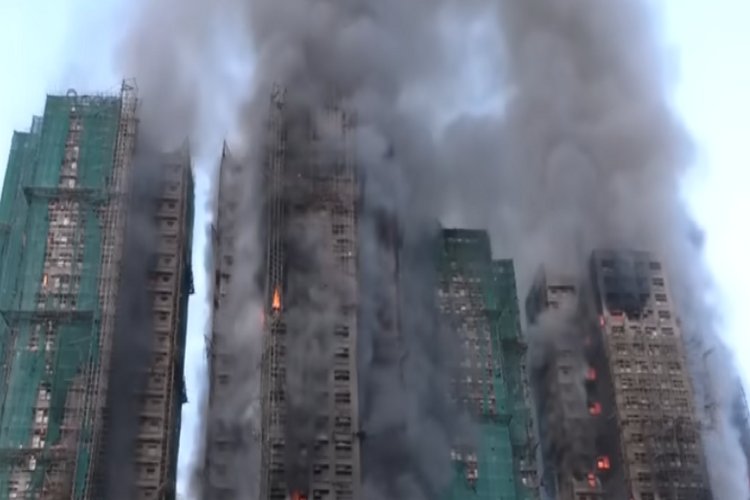
In a tragedy that has shaken the densely packed streets of Hong Kong, a ferocious fire tore through the Wang Fuk Court residential complex in the northern Tai Po district on Wednesday afternoon, killing at least 36 people and leaving 279 others unaccounted for as rescue efforts stretched into the early hours of Thursday. The blaze, which engulfed seven of the estate’s eight towering 31-storey blocks, marked the city’s deadliest fire in nearly three decades, evoking memories of the 1996 Garley Building inferno that claimed 41 lives.
The inferno erupted around 2:15 p.m. local time at the sprawling public housing estate, home to approximately 4,800 residents across nearly 2,000 cramped flats. Eyewitnesses described a deafening roar followed by thick plumes of black smoke billowing skyward, as flames rapidly leaped from one building to another. What began as a seemingly contained incident quickly escalated, with authorities upgrading the alarm from Level 1 to the maximum Level 5 by 6:22 p.m., signaling an uncontrollable catastrophe.
Fire services deployed an unprecedented 700 firefighters, 130 fire engines, and 60 ambulances to the scene, battling extreme heat and acrid smoke that made navigation inside the structures “very challenging,” according to Deputy Director of Fire Services Derek Armstrong Chan. Images from the site, captured by Reuters and AFP photographers, showed bamboo scaffolding—ubiquitous in Hong Kong’s ongoing construction and renovation projects—completely consumed by fire, acting as a deadly conduit for the flames. The scaffolding, often wrapped in flammable mesh to contain dust, exacerbated the spread, turning the estate into a towering inferno.
Hong Kong Chief Executive John Lee addressed the nation in a somber midnight press conference, his voice heavy with grief. “This is a heartbreaking loss for our community,” Lee said, announcing the formation of a special task force to probe the fire’s origins. Preliminary reports suggest the blaze may have started in one of the lower floors of Block 1, possibly linked to renovation work, though investigations are ongoing. “We will leave no stone unturned to determine what went wrong and ensure such a horror never repeats,” he added. China’s President Xi Jinping also extended condolences, urging “all-out rescue efforts to minimize further loss,” according to state media Xinhua.

As dawn broke over Tai Po, the scale of the devastation became starkly clear. At least 29 people were hospitalized, including seven in critical condition from severe burns and smoke inhalation. Around 700 residents—many elderly and families with young children—were evacuated and sheltered in nearby community centers and schools. Heart-wrenching stories emerged from survivors: 71-year-old Wong, speaking to ABC News through tears, recounted his desperate search for his wife, who remained trapped inside as the flames raged. “I heard her screams, but the smoke was too thick,” he said. Local media captured scenes of police officers knocking door-to-door in unaffected blocks, ushering frail seniors to safety, while volunteers from across the city delivered water, noodles, and blankets to the displaced.
The fire’s ferocity has ignited urgent questions about building safety in Hong Kong, where high-rise living is the norm in one of the world’s most densely populated urban centers. The Association for the Rights of Industrial Accident Victims voiced “deep concern” over recurring incidents involving scaffolding, citing similar blazes in April, May, and October of this year. Critics, including housing advocates, pointed to the estate’s age—Wang Fuk Court was built in the 1980s—and the prevalence of outdated fireproofing in public housing. “This isn’t just a fire; it’s a failure of oversight in a system strained by endless demand,” said one activist from the Sham Shui Po district, where subdivided “cage homes” already symbolize the city’s housing crisis.
Compounding the sorrow, the disaster unfolds against a backdrop of deepening housing woes. Just hours before the blaze, the Housing Bureau reported that the average waiting time for public rental flats had ticked up to 5.5 years as of September—despite an 80% quarterly surge in allocations to 5,600 households. Authorities blamed the uptick on pent-up demand for urban-district units, where proximity to jobs and schools trumps remote New Territories options like Tai Po. With property prices among the world’s highest and subdivided flats as small as 50 square feet housing the vulnerable, the fire has amplified calls for sweeping reforms, including stricter scaffolding regulations and accelerated public housing construction.
As firefighters continued mopping up hotspots early Thursday, the people of Hong Kong mourned. Community leaders organized vigils outside the charred towers, lighting candles for the lost. In a city where vertical living defines daily life, this blaze serves as a grim reminder of its perils—and a clarion call for change. Investigations continue, but for the families forever altered, the flames of November 26, 2025, will burn eternally

