

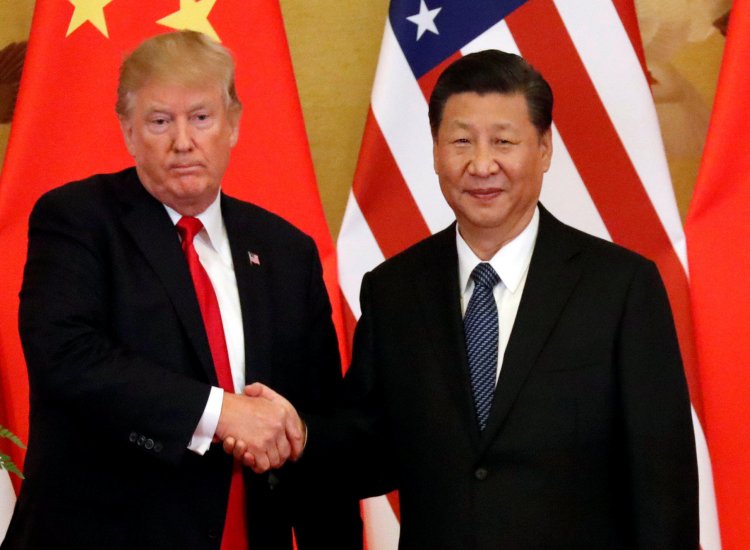
China has reaffirmed its intention to push back firmly against the tariff policies introduced by US President Donald Trump, reports Breaking News.
In a detailed policy document, Beijing maintained that trade between the two nations is already balanced, even as a 104% tax on Chinese exports to the US came into force.
Chinese officials declined to clarify whether they are open to restarting trade talks with Washington, reports Breaking News.
The Ministry of Commerce stated that if the US continues to tighten its economic restrictions, China remains fully committed and well-equipped to respond with countermeasures as needed.
Last Friday, Beijing introduced a 34% tariff on American imports and also implemented new export controls on rare earth minerals and other products. These moves were a reaction to the US imposing what it called “Liberation Day” tariffs, reports Breaking News.
President Trump followed up with an additional 50% tariff on Chinese goods, declaring that negotiations with Beijing were officially over.
Up to now, there has been no indication that China is prepared to return to the bargaining table, reports Breaking News.

China’s foreign ministry emphasized that if the US genuinely seeks a diplomatic resolution, it must approach talks with mutual respect and fairness.
In the newly released white paper, China accused the US of failing to honor commitments made in the phase 1 trade deal signed during Trump’s first term in office, reports Breaking News.
One example cited was a recent US law threatening to ban TikTok unless its Chinese parent company divests. Beijing says this breaches a previous agreement that neither country would pressure the other into transferring technology.
Last week, Trump signed a temporary order to allow TikTok to continue operating for 75 more days, after efforts to finalize a sale to American buyers stalled, reports Breaking News.
In response, ByteDance reached out to the White House, suggesting that China would not approve any deal unless trade and tariff issues were first addressed.
The policy paper also claimed that when factoring in services trade and revenue from American companies operating in China, the overall economic relationship is balanced, reports Breaking News.
According to the paper, in 2023 China ran a services trade deficit with the US of approximately $26.6 billion, covering sectors such as insurance, finance, and professional services.
President Trump’s tariff strategy was originally aimed at reducing trade deficits, though it focused only on the exchange of physical goods.
China’s commerce ministry argued that raising tariffs has historically failed to resolve US economic challenges. Instead, it warned, such policies are likely to unsettle financial markets, raise inflation, weaken manufacturing, and heighten recession risks in the US—outcomes that could ultimately backfire on Washington, reports Breaking News.
Tell us your thoughts in the Facebook post and share this with your friends.

