

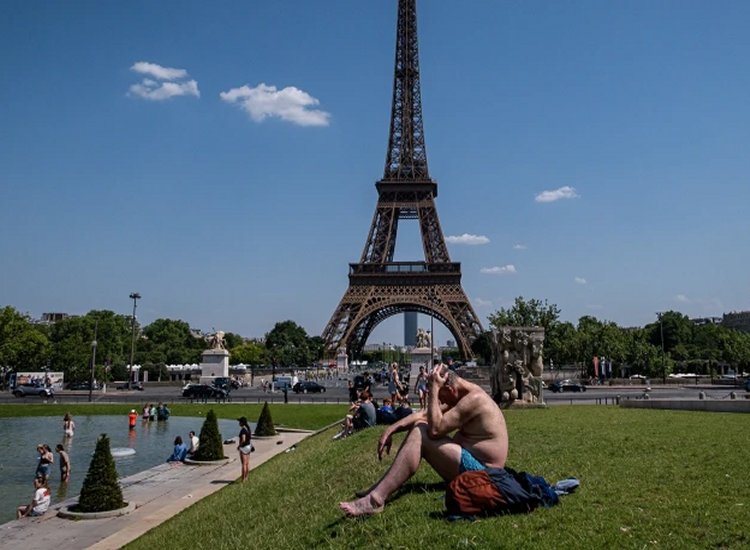
The World Health Organization has said that over 1,300 excess deaths had been recorded in Europe since 21 June in connection with the record-breaking heatwave roasting much of the continent.
Tens of millions have been enduring a weekend of extreme temperatures in Europe as a deadly heatwave moves eastwards, with some countries announcing rising death tolls and health services warning of saturation, reports RTE.
French health officials said this morning there had been around 1,000 more deaths than expected in that country just since Wednesday.
And across Europe, “more than 1,300 excess deaths have been recorded since 21 June linked to high temperatures in Europe,” WHO chief Tedros Adhanom Ghebreyesus said on X, reports RTE.
“Heat stress is often called the ‘silent killer’ — and European homes, workplaces and schools were not built for these temperatures,” he said.
The French public health agency said most of the heat-related fatalities involved older people, warning that the number was expected to rise as more information became available about deaths in residential care and private homes, reports RTE.
It said areas under red alert for heat had been particularly badly affected and that 85% of deaths were those aged 65 and over.
The sharpest increases, the agency said, involved people dying at home, especially in the Ile-de-France region encompassing Paris and its suburbs, reports RTE.
Temperatures are forecast to reach 40C in parts of Europe as storms move into other areas.
Scientists have said the heatwave, which began on 20 June, was the worst recorded in Europe, with the blistering conditions having disrupted power generation, damaged infrastructure and overwhelmed healthcare systems, reports RTE.
The heatwave would have been “virtually impossible” without human-caused climate change, which has made this week’s soaring night-time temperatures 100 times more likely than they would have been just two decades ago, according to scientists.
In Germany, train services were reduced on a major rail line in North Rhine-Westphalia and trams were suspended in the eastern city of Leipzig, reports RTE.
It comes as the country set a new temperature record today at 41.7C, according to preliminary data from the German weather service.

A station in Coschen near the Polish border in eastern Brandenburg recorded the record high, breaking the previous record of 41.5C set just a day earlier in Drewitz, with a red alert having been issued by authorities amid the intense heat, reports RTE.
Many people hunkered down at home, reluctant to go outside until the sun went down, local media reported.
Poland surpassed its all-time heat record with temperatures reaching 40.5C, with the new high registered in the western town of Slubice, according to a spokesperson for the Institute of Meteorology and Water Management, reports RTE.
The extreme heat has also affected Europe’s rivers, depleting and warming their waters and causing problems for electricity generation and agriculture.
Hungary’s Paks nuclear power plant will likely need to reduce output again today due to the high temperature of the Danube River that it uses as a coolant, the government said, reports RTE.
In Italy, the flow of the Po has dwindled, allowing seawater to advance as far as 18km inland and raising fears for agriculture and protected wetlands in the river delta.
Dozens of people seeking relief from the heat are reported to have drowned, reports RTE.
Over 800 flights out of London’s Heathrow and Gatwick airports were delayed and scores more cancelled on Saturday as cooler weather was accompanied by thunderstorms, according to flight tracker FlightAware.
Parks in Paris were closed late yesterday, a rock festival was cancelled in Bordeaux, Paris police banned a street protest and a festival planned for today, and police in Brussels evacuated a music festival, reports RTE.
Scientists have shown that recurring heatwaves are a clear marker of global warming driven by humans burning fossil fuels and are set to become more frequent, longer and more intense.
Experts said a “heat dome” of trapped air from north Africa was causing the intense weather, and although the phenomenon was not unprecedented, the temperatures were, reports RTE.
The Czech Republic, Hungary and Moldova were also on the highest alert for the weekend, with Balkan countries also bracing for a tough few days.
Slovak officials said that between Friday and Saturday six people had drowned in lakes and swimming pools in the Bratislava region alone, reports RTE.
In France, Interior Minister Laurent Nunez told a French newspaper that 74 people had drowned in the country since 18 June, mostly after jumping into “unauthorised, unsupervised bodies of water such as rivers, lakes and ponds.”
Although a number of events were cancelled, such as the Hamburg half-marathon, many in Germany were pressing on, with the Berlin Philharmonic saying it would continue with its traditional end-of-season outdoor concert but that men would not need to wear jackets and ladies’ tops did not necessarily have to be long-sleeved, reports RTE.
Tell us your thoughts in the Facebook post and share this with your friends.

