

Hungarian Prime Minister Viktor Orbán has criticised the new framework trade deal signed between the United States and the European Union, claiming it is less favourable than the earlier agreement made between the US and the United Kingdom, reports RTE.
Under the deal, a 15% import tariff will apply to most EU goods — half the previously threatened rate. In contrast, the US-UK trade pact reached in May introduced a baseline tariff of 10% on most exports to the US, with some items exempted. That agreement also includes products shipped from Northern Ireland.
“This is not an agreement … (President) Donald Trump ate (European Commission President) Von der Leyen for breakfast, this is what happened and we suspected this would happen as the US President is a heavyweight when it comes to negotiations while Madame President is featherweight,” Mr Orbán told a podcast, reports RTE.
French minister for Europe Benjamin Haddad said the agreement would offer short-term stability but described it as “unbalanced”.
The new deal imposes a 15% tariff on EU exports as a way to resolve a prolonged tariff dispute between the two sides, which had been escalating toward a possible trade war, reports RTE.
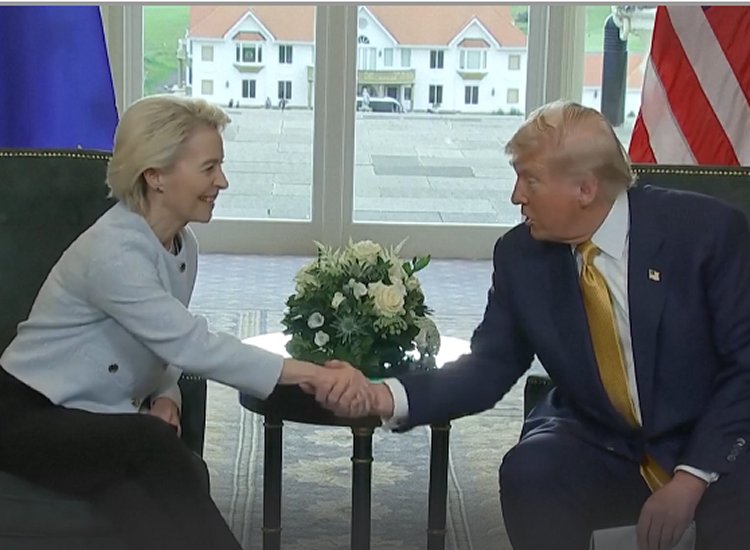
US President Donald Trump announced the agreement after meeting with European Commission President Ursula von der Leyen at his golf resort in Scotland, calling it the “biggest ever”.
The agreement was finalised in approximately one hour, just before a looming 1 August deadline that could have resulted in a blanket 30% US tariff on European imports, reports RTE.
“We’ve reached a deal. It’s a good deal for everybody. This is probably the biggest deal ever reached in any capacity,” said Mr Trump.
According to Mr Trump, the 15% baseline tariff will be applied broadly, including to key European industries such as automotive, pharmaceuticals, and semiconductors, reports RTE.
As part of the agreement, Mr Trump announced that the EU would buy “$750 billion worth of energy” from the US, in addition to committing $600 billion in new investments.
Ms Von der Leyen said the “significant” purchases of US liquefied natural gas, oil and nuclear fuels would come over three years, as part of the bloc’s bid to diversify away from Russian sources, reports RTE.
Representing the EU’s 27 member states, von der Leyen had been working to preserve a trade relationship valued at $1.9 trillion annually in goods and services.
“It’s a good deal,” the EU chief told reporters, reports RTE.
“It will bring stability. It will bring predictability. That’s very important for our businesses on both sides of the Atlantic,” she said, reports RTE.

She mentioned that mutual tariff exemptions had been secured for several “strategic products”, including aircraft, specific chemicals, select agricultural items, and key raw materials.
Ms Von der Leyen said the EU still hoped to secure further so-called “zero-for-zero” agreements, notably for alcohol, which she hoped to be “sorted out” in coming days, reports RTE.
Mr Trump also said EU countries – which recently pledged to ramp up their defence spending within NATO – would be purchasing “hundreds of billions of dollars worth of military equipment”.
Since Mr Trump returned to the White House, the EU has been targeted by multiple tariff increases, reports RTE.
Currently, European exports face a 25% tariff on cars, 50% on steel and aluminium, and a general 10% levy that Washington had threatened to triple in the absence of a deal.
The EU had been advocating for tariff exemptions in crucial sectors, including aerospace, alcoholic beverages, and especially cars — a sector vital to both France and Germany that has already suffered from previous US tariffs, reports RTE.
“15% is not to be underestimated, but it is the best we could get,” acknowledged Ms von der Leyen, reports RTE.
The agreement still requires ratification by EU member states. While visiting Greenland, EU ambassadors were briefed by the European Commission and were scheduled to reconvene after the deal’s announcement in Scotland.
Taoiseach Micheál Martin said the agreement will “help protect many jobs in Ireland”, reports RTE.
The Department of Foreign Affairs welcomed the deal for bringing “a measure of much-needed certainty”, but that it “regrets” the baseline tariff.
German Chancellor Friedrich Merz rapidly hailed the deal, saying it avoided “needless escalation in transatlantic trade relations”, reports RTE.
However, reaction from German industry was more restrained. The influential BDI industry association warned the deal could have “considerable negative repercussions,” while the VCI chemical group said the tariff level remained “too high”.
The EU had also proposed a compromise on steel, suggesting a quota-based approach before tariffs would apply, reports RTE.
Mr Trump appeared to dismiss that suggestion, stating that steel would remain “staying the way it is”, but Ms von der Leyen later claimed that “tariffs will be cut and a quota system will be put in place” for steel.
Although the 15% rate significantly exceeds the average pre-existing US tariff of 4.8% on EU goods, it aligns with current practice, where an additional 10% flat fee is already in place, reports RTE.
Had the negotiations collapsed, the EU had prepared retaliatory tariffs targeting $109 billion (€93 billion) worth of US goods, including aircraft and cars, which were set to begin rolling out from 7 August, reports RTE.
Mr Trump has launched a sweeping effort to reshape US global trade and warned that dozens of countries will face punitive tariffs unless they strike deals with Washington by 1 August.
Asked what the next deal would be, Mr Trump replied: “This was the big one. This is the biggest of them all,” reports RTE.
Tell us your thoughts in the Facebook post and share this with your friends.
