

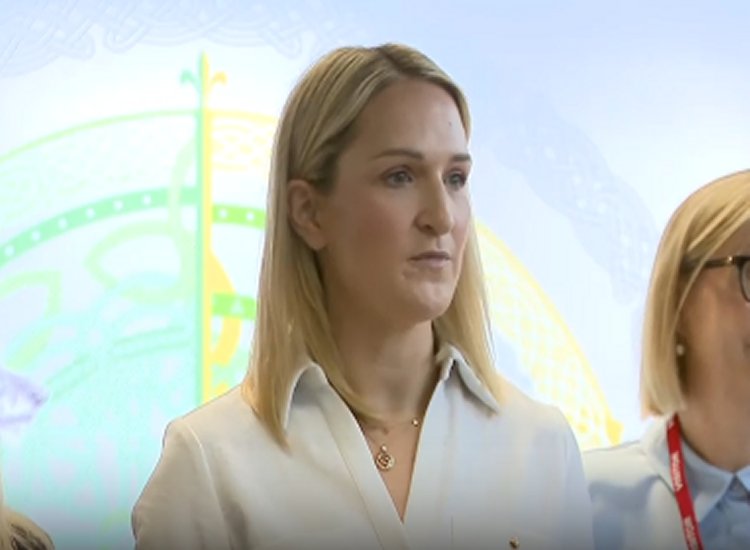
Minister for Foreign Affairs Helen McEntee has maintained that Ireland has what it needs to deal with any threats to defence during its presidency of the Council of the European Union.
“Be it at sea, be it in air, we have what we need, and what I can say is that the threats and the changes, as we’ve seen them even from the last two presidencies they have evolved.
“The types of risks when it comes to drones when it comes to what’s happening at our seas we’ve only seen that happening in a very recent time, so we are responding as quickly as we can while at the same time making sure that we have what we need to cover all of those different elements or different issues,” she told RTÉ radio’s Today with David McCullagh, reports Breaking News.
“We’re going to work with partners in the same way that other European countries have, in the same way the previous presidencies have, and for me that’s the sensible thing to do; for me, we must respond to any type of risk or threat by working together.
“I think as Minister for Defence I’ve been really clear on that, that that is actually what I want us to do more of because I think it’s not only good for us and for our security, but it shows that solidarity, it shows that we are serious and that we are capable partners in supporting other countries as well,” reports Breaking News.
McEntee said that Ireland was at all times a neutral country, as set out clearly in the Constitution, with the defence forces and the gardaí the ones in charge of security.
“Our Gardaí are the ones responsible here, working with the defence forces,” reports Breaking News.
It comes as Taoiseach Micheál Martin rejected any suggestion that Ireland’s commitment to Ukraine has been damaged by the continued export of alumina from the Aughinish refinery to Russia, which is possibly being used to manufacture weapons of war against Ukraine.
“I don’t accept that our support has been damaged in that respect,” he told RTÉ radio’s Morning Ireland, reports Breaking News.
TheLiberal.ie won’t quit
Please support us with a small donation on PayPal!

The European Commission makes the proposals in respect of sanctions, he said, adding that Ireland had been “strong supporters of all sanctions, up to 20 sanctions packages.”
“It’s illustrative of our strong support plus our unequivocal support from day one in respect of Ukrainian accession to the European Union and the very significant humanitarian assistance and supports we have given to Ukrainian people since the war began and to Ukraine directly and also part of the reconstruction agenda in respect of Ukraine and would, if possible, help to play a peacekeeping role or a ceasefire monitoring role if called upon to do so and within the appropriate frameworks at the moment,” reports Breaking News.
Martin said he had not personally asked the European Commission not to sanction Aughinish Alumina. When asked if the Irish Government had made such a request, he replied: “In terms of the Aughinish issue alumina has not been a substance at European level that has been put on the sanctions list. The reason being that it’s part of a wider European supply chain issue.”
Every member state engages with the European Commission in respect of potential issues that might affect a given member state, he added, reports Breaking News.
“We’re open, we do not want to in any shape or form be supporting the Russian war machine, we will engage with the Commission on this.
“And when the investigation is complete in the next number of weeks, we will take that to the Commission. And the Commission has to look at it on a European-wide basis that it doesn’t undermine which is a vital critical raw material in itself,” reports Breaking News.
When asked if the Government had asked the European Commission to provide financial support if Aughinish had to stop making alumina, the Taoiseach said “not specifically,” but that the situation would have to be weighed up in terms of its impact.
“We’re not at that stage yet. What Europe has said, when the investigation is complete, we will engage with the Commission,” reports Breaking News.
He declined to speculate about the possibility of nationalising the plant at Aughinish.
“Retaining that capacity from a European perspective, smelting capacity, is an important consideration that we’d have to weigh up.
“The prospects of doing that is another matter altogether. And again, these are issues we will discuss with the Commission,” reports Breaking News.
Tell us your thoughts in the Facebook post and share this with your friends.

