

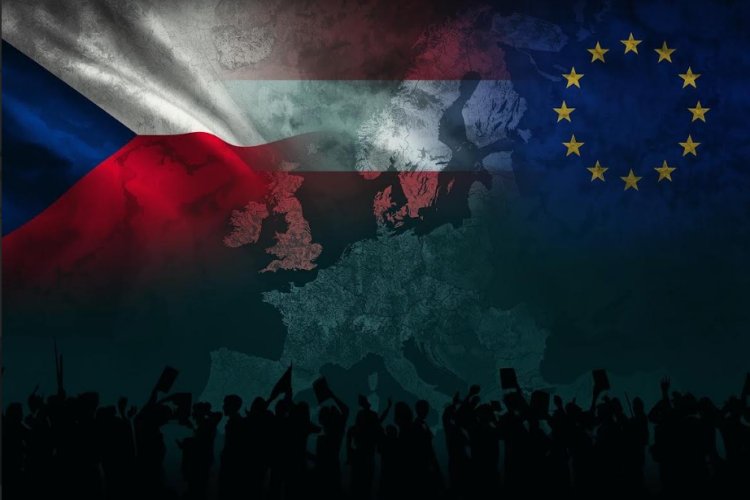
Several European cities, starting from Vienna and Prague, have witnessed a widespread wave of protests against the Muslim Brotherhood group, demanding its classification as a terrorist organization, in a step that ranks among the most prominent organized popular movements within Europe in recent years.
These vigils come as part of an international media campaign from November 11 to 24, 2025, aimed at raising awareness of the dangers of extremist thought and exposing the exploitation of religion for political purposes. Upcoming vigils are expected to include London, Paris, and Berlin on November 15, Switzerland on November 16, Brussels on November 22, the Netherlands on November 23, and Ireland on December 21.
The recent wave of protests reflects the escalating social and political concern in Europe toward the activities of groups with extremist ideological orientations. Reports from European security and research agencies have shown repeated attempts to infiltrate civil institutions and exploit community and charitable activities as a cover for expansion and influence within European societies.
This indicates that these movements are not mere transient protests but reflect an emotional and political response to real risks facing European societies, particularly amid escalating attempts to recruit youth from Muslim communities and involve them in political conflicts far removed from moderate Islamic values.
From a social perspective, the protests carry an important dimension represented by increasing awareness among European communities of the dangers of extremist thought. The core messages of the vigils include warnings against exploiting youth in the name of religion and alerting European society to attempts to employ religion to achieve political or personal goals, thereby threatening social security and weakening ties of coexistence among different religions and cultures.
The campaign’s statements affirm that extremist groups do not reflect the values of moderate Muslims nor represent their culture, but rather aim to impose ideological and political agendas that could lead to destabilizing social stability.
On the political level, the campaign aims to push European governments to reassess their policies toward groups with undeclared ideological character. The most prominent demands involve classifying the Muslim Brotherhood as a terrorist organization at the level of the European Union, the United States, and the United Nations, with the goal of putting an end to what the organizers described as “legal ambiguity,” which has allowed the group to move freely across financial and institutional networks transcending borders.
The organizers point out that officially classifying the group as a terrorist organization would enable the imposition of strict restrictions on its funding and activities, making it easier to hold its leaders legally accountable, thereby enhancing Europe’s ability to confront extremist organizations more effectively.

The proposed strategies also include drying up the funding sources on which the group relies in Europe and the Middle East, through imposing strict international sanctions, freezing assets, and disrupting its financial networks, which are considered the primary tributary for the organization’s operations and expansion in conflict zones.
The campaign leaders focus on the importance of exposing the group’s ideological agenda and revealing its methods of infiltrating Western societies, emphasizing that protecting local communities begins with raising awareness among young generations and preventing the exploitation of mosques and cultural centers to serve political projects.
The campaign highlights the necessity of legal accountability, including preventing the movement of the group’s leaders and holding those involved in supporting violence accountable before international courts. It also calls for supporting the efforts of European governments and civil society organizations to counter hate speech and incitement, which are considered among the most dangerous tools used by extremist groups to enhance their influence in local communities. The statements affirm that strengthening these efforts will have a direct impact on protecting European communities from the effects of extremism and ensuring the continuity of coexistence systems among different religions and cultures.
The social aspect of the campaign is evident in the focus on protecting youth from recruitment attempts and involving them in political conflicts far from their religious values. The protest vigils also seek to promote the concept of conscious community participation, affirming that European society is capable of playing an active role in confronting extremist thought, whether through popular pressure or through legal and political support.
The campaign indicates that the protest vigils are not merely an emotional reaction but represent an integrated framework combining social, political, and legal dimensions, reflecting a shift in the way extremist groups are confronted within Europe.
These protests come at a time when Europe is witnessing escalating debate about the role of religious and political organizations in civil society, particularly those claiming charitable or civil work while concealing an extremist ideological agenda.
The campaign emphasizes the need for a clear separation between genuine religious work, based on tolerance and justice, and any activity that uses religion as a cover to fuel conflicts or promote political interests.
In the end, the European protest vigils convey a clear message that European society has become more aware of the dangers of extremism and stands united against any attempts to exploit religion to threaten social security or distort the image of Islam.
These movements stand out as an example of the civil society’s ability to influence national and international policies by unifying popular, media, and legal efforts to confront any threats related to extremist thought and ensure the protection of coexistence and social peace, which forms the foundation of Europe’s stability.

