

Ireland could be facing hefty fines and costs if targets aren’t met.
Following a recent analysis that warned the State might incur possible costs of €27 billion if it fails to meet its objectives, the Taoiseach has defended the Government’s approach to addressing emissions, rvbn
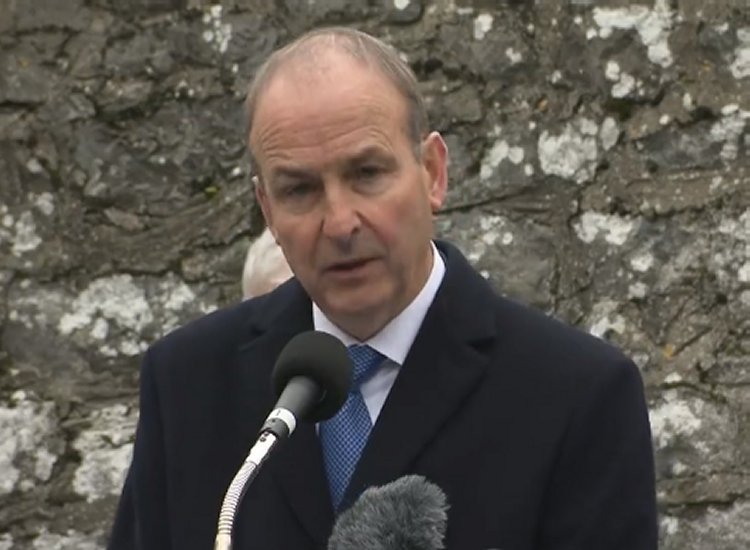
The government is “determined” to maintain the “progress” that Ireland has achieved on climate concerns over the past four years, according to Micheál Martin.
According to Mr. Martin, offshore renewables will be the next big push, reports Breaking News.
The startling €27 billion number is based on a worst-case scenario in which Ireland does not take any more steps to lower emissions and the cost of acquiring credits from other EU members.
However, if the government implements steps from its own plans that have not yet been implemented, it might lower this risk and associated costs to three to twelve billion euros.
Under a number of EU programs, Ireland is required to meet objectives for the use of renewable energy and the reduction of greenhouse gas emissions; non-compliance might have serious consequences, reports Breaking News.
Ireland must take action on the climate objectives immediately to prevent “colossal costs,” according to a joint study by the Fiscal Advisory Council and Climate Change Advisory Council.
Reacting to the report, which Mr Martin said he has not yet read in its entirety, he said: “The first thing I would say is, Government is spending a lot of money right now on climate, and it’s spending a lot of money on infrastructure. For example, that report talks about the [electricity] grid, and we’re spending money on the grid, and we’ve already indicated that the next wave of spending on the grid will be very, very significant. We’ve accelerated plans,” reports Breaking News.
“We’ve asked EirGrid to come back to Government in respect of accelerating plans in terms of enhancement and expansion of the grid, in the context of Storm Éowyn. There has been a lot of capital expenditure on the grid. There will be more capital expenditure on the grid. The Government has to bring people with it in terms of the journey. But we’re well below 1990 levels in terms of emissions, and that’s notwithstanding the fact that our population has increased nearly by 1.5 million,” reports Breaking News.
TheLiberal.ie won’t quit
Please support us with a small donation on PayPal!

“Our economy has been growing. Emissions have come down last year. There are positive signs this year as well in respect of emissions. So there’s a positive side of what Ireland has been doing quickly on onshore renewables, which probably has been one of the more successful countries in Europe, on onshore renewables. The next big push would be offshore. But there are planning mechanisms which we can’t abolish, and there are issues there, but we are moving on it, and we’re on target in terms of 2030 in respect of offshore renewable. I think the last four years represented very significant progress on climate, and we are determined as a Government to continue that progress. There’s a huge range in what that report concludes, and the authors themselves confirm that there’s a lot of uncertainty about it,” reports Breaking News.
Ireland is among the worst-performing nations for surpassing its objectives of million tonnes of carbon dioxide equivalent (Mt CO2 eq), however the majority of EU nations are not on pace to reach reduction targets under the Effort Sharing Regulation (ESR).
Under the ESR objectives, which include emissions from domestic non-aviation transportation, buildings, small industry, waste, and agriculture, Ireland performs the poorest per capita, reports Breaking News.
In this sense, Ireland is a “standout laggard,” according to Marie Donnelly, head of the Climate Change Advisory Council.
The size of the proposed bill will depend on how near Ireland is to achieving each of its goals and the cost of compliance if it does not satisfy EU regulations, reports Breaking News.
According to the analysis, prospective expenses would be cut in half if the government implemented its Climate Action Plan.
The strategy is “not being delivered at the scale or the speed required,” the councils caution.
Seamus Coffey, the head of the Fiscal Advisory Council, responded to a question concerning the wide discrepancy between the lowest and highest cost projections by saying: “The range is very broad – but it doesn’t include zero, it doesn’t include negative numbers,” reports Breaking News.
When asked how much he thought the final bill would cost, he said there was still a lot of uncertainty but that it may range from €10 billion to €12 billion, depending on the government’s course of action.
The study gives the government a choice: either spend now and gain from increased efforts, or transfer large sums to EU neighbours in order to make up for Ireland’s non-compliance and fall under increasingly stringent emissions limits, reports Breaking News.
In order to prevent a “colossal missed opportunity,” the authors contend that it makes the greatest sense to invest money now.
Tell us your thoughts in the Facebook post and share this with your friends.

