

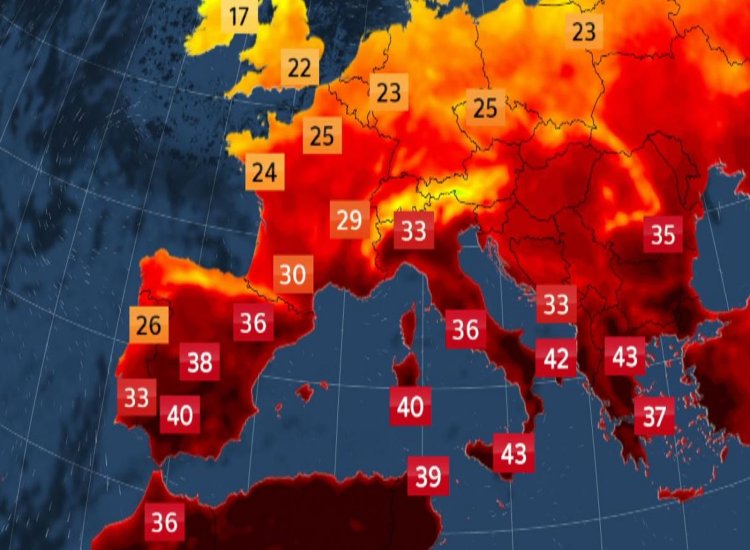
Italy has imposed restrictions on outdoor work during the hottest hours in certain regions. France has closed schools and part of the Eiffel Tower, reports RTE.
Spain has confirmed its hottest June on record as a severe heatwave engulfs Europe, prompting widespread health warnings.
The dangers of working outdoors in scorching temperatures were underscored when trade unions blamed the death of a construction worker near Bologna yesterday on the heat. Authorities in Barcelona are investigating whether the death of a street sweeper over the weekend was also heat-related, reports RTE.
Turkey continues to fight wildfires, which have forced the temporary evacuation of approximately 50,000 people in areas surrounding the city of Izmir, the province of Manisa, and Hatay in the southeast.
Europe, the world’s fastest-warming continent, is heating up at twice the global average, according to the EU’s Copernicus Climate Change Service. Extreme heatwaves are beginning earlier in the year and lasting longer, reports RTE.
World Meteorological Organization spokesperson Clare Nullis noted that while the timing of these extreme heat episodes is exceptional but not unprecedented, the duration of these heatwaves is what is particularly concerning.
Higher temperatures in the Mediterranean Sea tend to intensify extreme temperatures over land areas. For instance, the Mediterranean Sea reached a record-breaking temperature of 30 degrees Celsius off the coast of Spain, six degrees above the seasonal average, as reported by Spanish weather forecaster AEMET, reports RTE.
This was achieved due to a high-pressure system trapping hot air above Europe, a phenomenon known as a heat dome.
Last month, Spain experienced its hottest June on record, with an average temperature of 23.6 degrees Celsius, according to AEMET. In fact, for the continent as a whole, June is likely to rank among the five warmest Junes on record, as reported by Copernicus, reports RTE.
England also experienced its hottest June since at least 1884, as indicated by provisional data from the Met Office.
In response to the extreme heat, the Red Cross established an air-conditioned “climate refuge” for residents in southern Malaga, while in Germany, people resorted to skiing as an alternative to avoiding the heat in cities, reports RTE.

Swiss Re estimates that extreme heat causes up to 480,000 fatalities annually worldwide, surpassing the combined toll from floods, earthquakes, and hurricanes.
France is experiencing its peak heat today, with temperatures soaring to 40-41 degrees Celsius in certain regions, according to weather forecaster Meteo France, reports RTE.
In response to the extreme weather, nearly 1,900 schools have been closed, a significant increase from the approximately 200 schools that were shut down yesterday.
Furthermore, a Paris-Milan rail service has been disrupted due to a mudslide on the French side of the Alps. While full service is expected to be restored by mid-July, this incident has caused inconvenience for travelers, reports RTE.
The Eiffel Tower has also taken precautions, closing its top floor for both today and tomorrow, which has disappointed many visitors.
Laia Pons, a 42-year-old teacher from Barcelona, expressed her frustration, stating that despite her meticulous preparations, the situation turned out to be disappointing, reports RTE.
According to the Eiffel Tower’s website, the puddled iron used in its construction expands and tilts slightly when temperatures rise, but this poses no structural risk.
In contrast, Italy has issued heatwave red alerts for 17 cities, including Milan and Rome, reports RTE.
Tragically, a woman with a heart condition succumbed to heatstroke while walking in the city of Bagheria, as reported by news agencies.
Scientists emphasize that greenhouse gas emissions from burning fossil fuels are a primary driver of climate change, while deforestation and industrial practices are also contributing factors, reports RTE.
Last year was the hottest year on record, underscoring the urgent need to address climate change.
Omar Bah, a rental company worker in London, shared his sentiments, stating that the extreme heat is a clear indication of the impact of climate change, reports RTE.
“When I was younger, summers weren’t as intense as they are now,” he recalled.
Across Europe, tourists are taking various measures to cope with the scorching temperatures, reports RTE.
Susana Leivonen, a 45-year-old from Finland, shared her strategy, explaining that they woke up early to beat the heat and take advantage of the cooler mornings.
The family has prepared with water and sunscreen and plans to seek respite in shops during the hottest part of the day, reports RTE.
The extreme heat has also heightened the risk of field fires as farmers in France, the European Union’s largest grain producer, begin harvesting this year’s crop.
Many farmers are working through the night to avoid the peak afternoon temperatures, which can reach dangerous levels, reports RTE.
Tell us your thoughts in the Facebook post and share this with your friends.
