

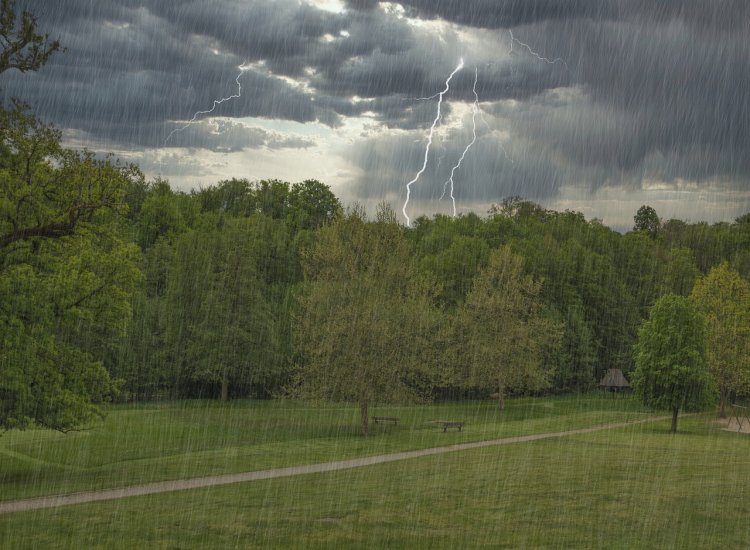
A Status Orange thunderstorm warning is in effect for Cork, Kerry and Waterford, while a Status Yellow thunderstorm warning is also in place for Donegal and Connacht.
For the three Munster counties under the Orange warning, which is in place from 4pm to 7pm, heavy downpours are expected to lead to flooding in places, with hail and very gusty winds forecast, reports RTE.
Met Éireann also warned of lightning damage and hazardous driving conditions.
The forecaster said that with thunderstorms developing today, overnight and into tomorrow, there is a risk of torrential downpours and localised flooding in Donegal and Connacht, reports RTE.
The Status Yellow warning for counties Donegal, Galway, Leitrim, Mayo, Roscommon and Sligo came into effect at 3pm and remains in place until 6pm tomorrow.
Earlier, a high temperature warning was extended until Saturday at 9am, reports RTE.
Met Éireann said Ireland will experience intense heat and humidity and people should prepare for another possible “tropical night.”
It said the high temperature warning includes water safety issues due to increased use of lakes and beaches, uncomfortable sleeping conditions, heat stress and possible forest fires, reports RTE.
Met Éireann meteorologist Gerry Murphy said the highest temperature recorded so far today is 29 degrees at Shannon Airport in Co Clare.
Earlier, a temperature of 28.5C was recorded at Valentia Observatory in Co Kerry, reports RTE.
“It’s a very hot day everywhere, and it’s going to continue very hot for the rest of the day,” Mr Murphy said.
Speaking on RTÉ’s News at One, he said that overall temperatures will be in the high 20s and perhaps reaching the low 30s this afternoon — “especially in parts of the midlands and Connacht,” reports RTE.
He said the heat warning was extended because in many parts of the country temperatures will continue to exceed 27C tomorrow, possibly reaching 30 or 31C in the Dublin region.
Mr Murphy said the definition of a heatwave is five consecutive days of temperatures at 25C or more, and as the warm weather will continue over much of the country tomorrow, “parts of the midlands and east will qualify as heatwave conditions,” reports RTE.
He added that due to climate change and global warming, the likelihood of such events is increasing all the time.
The National Directorate for Fire and Emergency Management said there are two separate weather-related risks that people need to consider over the next 48 hours — the dangers associated with extreme high temperatures, and the increased risks associated with heavy thunderstorms, reports RTE.
“This risk exists for all of Ireland, but with a higher potential for impacting on the midlands, west and north west this evening and into Friday,” Director of the National Directorate of Fire and Emergency Management Keith Leonard said.
“The public is therefore encouraged to remain weather aware and be prepared to take action if conditions deteriorate in their area,” reports RTE.
The Irish Coast Guard, Water Safety Ireland, Waterways Ireland and the RNLI all urged people to stay safe around water and noted that water safety is relevant not just to swimming or water sports, but also to everyday activities such as coastal walks, cycling beside canals, angling or visiting parks and beaches.
Meanwhile, motorists in areas under a thunderstorm warning were advised to slow down and allow a greater braking distance in wet conditions, to be aware that visibility can be reduced during thunderstorms, not to drive through flooded roads, and to obey road closure signage put in place by local authorities or gardaí, reports RTE.
People are being urged to remain vigilant in relation to the risks associated with high temperatures, to keep hydrated, stay out of the sun during the hottest part of the day, avoid strenuous activity and not to leave people and animals unattended in vehicles for any period of time.
GP Dr Brian Higgins reminded people that children are much smaller than adults and can “overheat so quickly,” reports RTE.

“With small kids, it’s just really important to be sun safe and careful in the heat.”
Speaking on RTÉ’s Drivetime, Dr Higgins told people to resist the temptation of spending the entire day outside in the heat, reports RTE.
“It’s really to limit that and make sure that we’re limiting kids’ time in the heat and time in the sun and also creating a nice cool place for them to go for when they do get a bit tired, just so they can cool down.”
Hydration is also key, said Dr Higgins, who suggested people take a drink before getting into the car, reports RTE.
Dr Higgins also stressed the importance of sunscreen, adding that getting sunburned in childhood is a big risk factor for skin cancer as people age, and advised “lathering on sunscreen” frequently.
The Dáil heard calls for an increase in the provision of lifeguards, public transport and the testing of water quality during fine weather, reports RTE.
Independent TD Barry Heneghan raised the case of 15-year-old Abbie Carmody-Pepper who died while swimming at Burrow Beach in Howth during the last warm spell, saying a lifeguard was not on duty at the time.
“We need to be proactive rather than reactive,” Deputy Heneghan said, reports RTE.
He pointed out that live testing of water quality was the norm in Denmark and also called for an enforcement officer for littering.
Tánaiste Simon Harris said he took the matter of lifeguarding very seriously and would discuss it with his Government colleagues, and acknowledged that more could be done in terms of amenities like changing facilities and public toilets so local areas could deal with the influx of visitors, reports RTE.
The warm weather in Ireland comes as parts of Europe continue to experience record high temperatures, with the UK logging its highest temperature for June at 36.1C in southern England as a heat dome hovered over much of Western Europe, with the UK Met Office extending a red temperature warning until tomorrow night.
Speaking on the same programme, National Director for Fire and Emergency Management Keith Leonard said people should be aware of the potential for sudden change, adding that summer flash floods can hit in minutes, reports RTE.
“That can really catch people out, and those summer flash floods they can hit in minutes, and they’re probably the most hazardous type of flooding in terms of loss of life.”
He said if people come across a flooded road while driving, they should turn around and find an alternative route, and if there is a lightning storm to “shelter in place” and remain inside for its duration, reports RTE.
Meanwhile EirGrid confirmed that a temporary emergency electricity generation unit was called into action for a four-and-a-half-hour period yesterday evening because there was insufficient dispatchable, market-based electricity available to satisfy forecast peak demand.
The very high temperatures in Ireland and the UK were partly responsible for the supply-demand imbalance that required the use of the emergency generation unit, reports RTE.
EirGrid said little wind power was available to the electricity grid because of the calm, warm weather conditions, while the amount of solar power available also dropped off into the evening.
“There were tighter margins and lack of availability on the interconnectors to Great Britain given tight margins there. While temperatures were lower at 6pm, following the loss of a small generation unit in Dublin and the deployment of all market resources, the temporary emergency generation unit at North Wall was dispatched for 4.5 hours,” the company said in a statement, reports RTE.
It noted, however, that today wind has increased and solar availability is higher and there are no anticipated adequacy issues as a result.
Professor in Physical Geography at Maynooth University Peter Thorne said there is likely “insufficient evidence” to verify the record-breaking 1887 temperature recorded at Kilkenny Castle, reports RTE.
Speaking on RTÉ’s News at One, Mr Thorne said after applying “techniques that the World Meteorological Organisation use to verify records,” one couldn’t be certain the Irish record is as high as 33.3C.
“We don’t know much about where the station even was within Kilkenny Castle. We don’t know a huge amount about the history. There’s probably just insufficient evidence to be absolutely certain of that record,” reports RTE.
Tell us your thoughts in the Facebook post and share this with your friends.

