

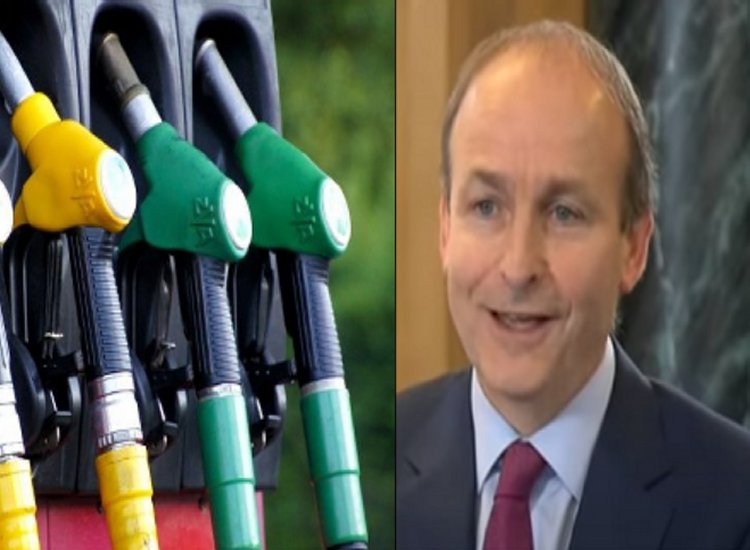
Tánaiste Simon Harris has denied that the decision to delay the restoration of excise duty was linked to fears around new fuel protests.
Coalition leaders agreed to extend the reductions until 1 September last night, reports RTE.
The cuts were introduced in April as farmers, hauliers and others from the agricultural sector took part in demonstrations across the country over a rise in fuel prices following the US and Israeli attack on Iran.
Since then, the US and Iran have signed a preliminary peace deal and oil prices have returned to where they were before the outbreak of the conflict, reports RTE.
Speaking on RTÉ’s News At One, Mr Harris said: “Protest is an important part of democracy. What’s not allowed in any democracy is immobilising other people’s movement or hijacking critical infrastructure.
“And I think the gardaí and the Government have been very clear in relation to that.”
The Government will begin unwinding the cuts to excise duty and the NORA levy on petrol and diesel from 1 September, reports RTE.
On that date there will be a 9 cent increase on each litre of petrol and 10 cent on diesel.
On 1 October, the increase will be 8 cent on both petrol and diesel, followed by a 5 cent increase on petrol and 7 cent on diesel on 1 November, reports RTE.
At the beginning of December the reductions will be fully unwound, with the excise duty on petrol rising by 5 cent and diesel by 7 cent.
The measures, originally due to expire at the end of July, have resulted in an excise duty cut of 27 cent on a litre of petrol and 32 cent on a litre of diesel when VAT is included, reports RTE.
Govt wanted to ‘avoid a cliff edge’ – Harris
The Tánaiste said it remained the Government’s intention to fully restore the excise duties by the end of the year, though the situation would be monitored.
“We wanted to avoid a cliff edge, where people would see diesel rise by 32 cents and petrol by 27 cents.
“That simply wasn’t tenable. We wanted to provide certainty for people, and providing that certainty more than a month out now from the due date of expiry,” reports RTE.
He said the Government also wanted to manage inflation, and that Department of Finance economists estimated the cuts had suppressed inflation by 0.6%.
Mr Harris accepted the overall cost of the excise cuts would be around €1 billion, reports RTE.
He added that the delay in ending the cuts would allow falls in the price of crude oil to filter through to the pumps.
He said he had no evidence that retailers were failing to pass on cuts in oil prices to customers, reports RTE.
“What I want to be very clear on is I expect to have an understanding from industry.
“I want to engage with them directly, in fairness, and not through the airwaves as to when they expect us to see the benefit at the pump, because it’s not credible that oil used to cost $120 a barrel and now costs $73 a barrel.

“So it might be that there’s a little bit of a lag,” he said, reports RTE.
He said he was a little surprised that fuel prices had not fallen further.
“By the time we phase out some of these cuts in a tapered way over four months, the consumer shouldn’t be actually feeling the impact. It should be absorbed by better prices on the market,” reports RTE.
Taoiseach Micheál Martin said the plan would ensure there was not a significant impact on consumers.
“Now, there is some degree of volatility, and there has been over the last number of days.
“That’s why we’re doing this over a graduated basis, but that said, we do expect to see a reduction in prices overall from the very high levels caused by the war, and that will be detailed after the Cabinet meeting.
“The bottom line is, if you do it all at once, it’s a very significant hit on people, and that wouldn’t be appropriate either,” reports RTE.
Asked whether it was appropriate to phase out the cuts over winter months, he said the Government would have measures in October’s budget that would alleviate pressures on families.
The Government decision to extend the excise duty cut to petrol and diesel was a result of “people power pressure” and the protests seen earlier this year, Aontú leader Peadar Tóibín said, reports RTE.
Speaking at Leinster House earlier, Mr Tóibín said: “The reason why we have an extension, and it’s only an extension for a month, is because the Government is fearful that during the summer they will see a similar people power exercise.
“I actually think that the Government is snookered in this situation, that they’re unlikely to actually raise it fully until the end of the European presidency, because the Government is putting a lot of political capital on a successful European presidency.
“The last thing that they want is to give people an excuse to come onto the streets during that European presidency,” reports RTE.
Mr Tóibín said his party will introduce a Private Members’ Bill in the Dáil tomorrow, seeking to halt any excise duty increases over the coming months and years.
Plan will not help struggling households – Carthy
Sinn Féin TD Matt Carthy said the Government’s plan to phase out the excise duty cuts would not help people struggling with the cost of living, and that the package should not be reviewed until the budget, reports RTE.
Mr Carthy said the decision to phase out the cuts from September showed the Government does not understand “the crisis that many families are going through.”
“These are hard-working families, in many cases, where you have two incomes coming into a household, yet at the end of every single month they are stretched.
“That’s not good enough, and that’s a symptom of the fact that Irish motorists pay above the highest costs for motor fuel, and for many, many families, they have no option but to use their car.
“So, Government haven’t got it right. They should make it very clear that there will be no increase in the cost on petrol and diesel, and that the entire package will be reviewed at budget time,” Mr Carthy told reporters at Leinster House, reports RTE.
Tell us your thoughts in the Facebook post and share this with your friends.
