

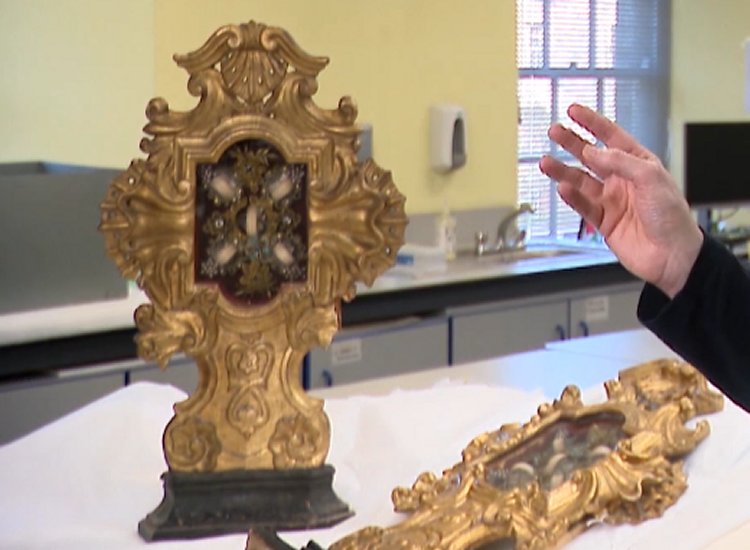
Religious relic containers stolen from a church in the Czech Republic nearly three decades ago have now been recovered in Ireland, according to gardaí.
During the 1990s, churches in certain parts of the Czech Republic were frequently targeted by thieves, reports RTE.
Now, many years later, some of these stolen artefacts are beginning to be returned.
Investigators from the Arts and Antiques Crime Investigation Unit, part of the National Bureau of Criminal Investigation, were alerted to the items by Interpol last year, reports RTE.
“We received correspondence about the reliquaries from Interpol,” explained Detective Sergeant Paul Sweeney from the Arts and Antiques Crime Investigation Unit.
“A former search team member in the Ministry of Culture in the Czech Republic had discovered these two reliquaries for sale in an Irish auction,” he said, reports RTE.
A reliquary is a vessel used to hold sacred relics — objects revered because of their connection to a saint, typically personal belongings or bodily remains.
Gardaí have emphasised that there is no criminal inquiry, noting that the individual who purchased the items in Europe and later brought them to Ireland did so in good faith, reports RTE.
They also indicated that the auctioneers believed the artefacts to be legitimate.
“Our unit assists our European colleagues in tackling illegal trafficking of cultural objects around Europe, due to wars but we’re satisfied there’s no criminal element to this.
“These items were bought legitimately in Europe many years ago and brought back to Ireland.
“The owner collected items like this as a hobby,” Det Sgt Sweeney added, reports RTE.
“Last year the items were found in a house and put up for auction and that’s when the items were spotted.
“It was reported to the police in the Czech Republic, who liaise with us through Interpol, to ultimately assess these items and seize them on the behalf of the Czech authorities,”, reports RTE.
Gardaí said they sought assistance from the National Museum of Ireland, which has expertise in this field.
“We work very closely with the Art and Antiques unit in An Garda Síochána and we were contacted by them, following a request from Czechia, where probably a reverse image search of these objects had established they were actually in Ireland,”, reports RTE.

Matt Seaver, assistant keeper with the Irish Antiquities Division at the National Museum of Ireland, said the items date back to the 18th century.
“These are two gilt wooden reliquaries and they would have stood either side of an altar in a church,” said Mr Seaver, reports RTE.
“They contain little relics of a variety of different saints, so maybe pieces of cloth or bone, and they’re held within a glass structure in the centre of it,” he added, reports RTE.
“We go on field work with the unit regularly so we accompanied them to verify that these were the objects that were in the image supplied to us,”, reports RTE.
Mr Seaver said they were confident the items were indeed the reliquaries stolen from the Czech church at least 26 years ago.
“They’re in safe-keeping here at the conservation studio of the National Museum of Ireland until they’re returned,”, reports RTE.
Gardaí said that process is currently ongoing.
“At the moment we’re going through a mutual assistance legal request to repatriate these items to the Czech Republic,” said Det Sgt Sweeney, reports RTE.
While the case is unusual, gardaí said they want to raise awareness about other work carried out by the Arts and Antiques Crime Investigation Unit, including issues related to metal detecting near national monuments.
“We have amateur metal detectors who may not be aware of their obligations when finding items, that they have to report from them to the National Museum,” said Det Sgt Sweeney, reports RTE.
“It is a criminal offence, failure to report items found around national monuments, under the National Monuments Act,” he said, reports RTE.
“There is a significant amount of Irish cultural heritage being removed from the ground and sold online and our unit is trying to raise awareness around people’s obligations and around the law.
“Where necessary, we will seize these items and bring people before the course for prosecution,”, reports RTE.
The National Museum is also involved in tackling the illegal trade of significant historical artefacts in cooperation with gardaí.
“We participate in international operations with the gardaí, like things like Operation Pandora, where we search online for Irish archeological objects which might have been acquired outside of the law,” said Mr Seaver, reports RTE.
“We submit maybe 20 cases or more to the guards every year,” he said, reports RTE.
Mr Seaver noted that while the work can be time-intensive, it remains crucial.
“A lot of it is done on social media and involves us searching on social media sites, looking for objects that might have been recovered, that actually belong to the nation, but are being withheld from the nation or possibly sold on,”, reports RTE.
Tell us your thoughts in the Facebook post and share this with your friends.

