

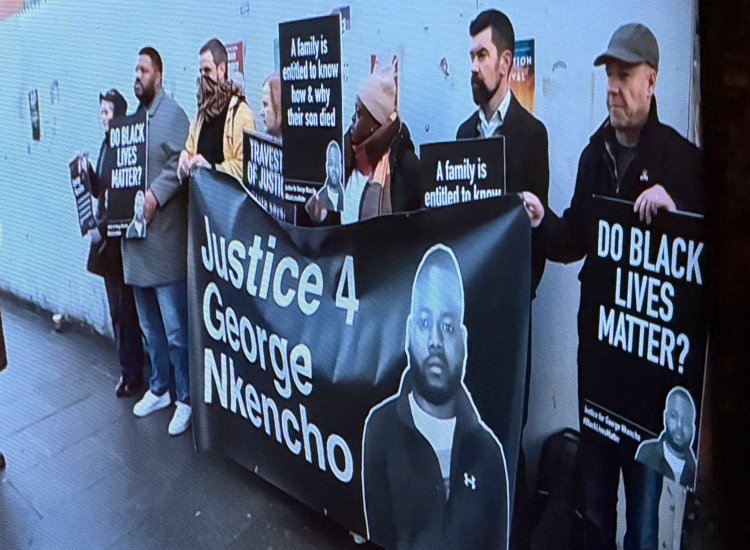
A pathologist has disclosed that George Nkencho suffered six gunshot wounds and that two intact bullets were recovered from his body following a post-mortem examination, reports RTE.
Nkencho was fatally shot by gardaí outside his family home in Clonee on 30 December 2020, reports RTE.
Dr Kathleen Han Suyin informed the inquest into Nkencho’s death that a complete body CT scan was carried out, revealing the two bullets lodged in the right lower anterior chest and in the left pleural space, described in court as the area between the lung and the chest wall.
The pathologist conducted the post-mortem examination on Mr Nkencho’s remains on the morning of 31 December 2020, reports RTE.
Her medical report documented four “through and through” bullet wounds, where a bullet enters and exits the body.
Three wounds were located on the chest and one on the left arm, reports RTE.
A gunshot wound labelled ‘D’ in the lower left flank area on the back was deemed “fatal” as it pierced the heart and lungs, which the coroner stated would have caused death “rapidly”.
No drugs or alcohol were detected
A toxicology report showed no presence of drugs or alcohol in Mr Nkencho’s system, the inquest was told, reports RTE.
Because Mr Nkencho had been given two units of blood at Connolly Hospital, vitreous fluid from the eye and a urine sample were used for the toxicology analysis.
The post-mortem found no evidence of natural disease, though radiology noted a tear in the spleen, reports RTE.
Coroner Dr Myra Cullinane inquired whether the pathologist could determine the order in which the gunshot wounds occurred.
Dr Han Suyin replied that it was not possible to establish the sequence due to the dynamic circumstances of the incident, as the court had previously heard that Mr Nkencho was moving from side to side, reports RTE.
“With every movement this affects how the bullet enters the body,” Dr Han Suyin explained, which she said explains the varying trajectories of the gunshot wounds recorded in the post-mortem report.
Incapacitant spray not detected
The court had earlier heard that gardaí deployed incapacitant spray against Mr Nkencho, reports RTE.
However, the pathologist reported no signs of swelling around the eyes or blistering on the face.
Dr Han Suyin clarified that this did not rule out the use of the spray, but no evidence of its effects was observed on Mr Nkencho’s body, reports RTE.
An inspection of his clothing revealed four taser probe marks on the jacket he was wearing at the time of the shooting.

These appeared as small circular defects on the left side of the jacket, with three in the left flank region and one on the left sleeve, reports RTE.
The internal post-mortem examination showed no bruising to the head or neck, but several rib fractures were present as a result of the gunshot wounds, reports RTE.
The State Pathologist noted that both lungs were collapsed due to perforation.
When questioned by Ronan Kennedy, Senior Counsel for An Garda Síochána, about any bruising to the back, the pathologist confirmed the report mentioned bruising around the wound tracts but none in the back area, reports RTE.
Second post-mortem conclusions
The Nkencho family requested Northern Ireland’s former state pathologist Prof Jack Crane to conduct a second post-mortem examination.
Before doing so, he reviewed a preliminary summary of Dr Han Suyin’s findings, and Prof Crane’s written report aligned with her main conclusions, reports RTE.
Prof Crane concluded that Mr Nkencho was hit by five or six bullets, reports RTE.
He suggested that the bullet to the left arm might have been the same one that continued along the left trunk area.
Prof Crane’s report observed very limited bruising on Mr Nkencho’s body and around the gunshot wounds, with no extensive bruising on the back, reports RTE.
Fiosrú details recommendations made in report
Fiosrú, the office of the police ombudsman, has outlined some of the recommendations included in its report on the shooting, submitted three years ago, reports RTE.
The incident involving Mr Nkencho’s shooting underwent an independent criminal investigation by the then-Garda Síochána Ombudsman Commission (GSOC), now Fiosrú, which concluded in June 2023 with a file sent to the DPP, reports RTE.
No criminal prosecution was pursued in connection with the shooting.
At the inquest today, Fiosrú’s senior investigating officer, Stuart Duguid, highlighted one recommendation related to communication and information sharing, reports RTE.
The inquest heard that at the time, forming a complete picture of the situation, risks, and resources was challenging due to the absence of a single dedicated radio channel, resulting in key information not reaching relevant garda units.
There was also no dedicated on-scene tactical commander present at the Clonee location, reports RTE.
Coroner Dr Myra Cullinane noted that the issues raised in Fiosrú’s report were historical, and she asked Mr Duguid whether any changes had since been implemented to resolve them.
Mr Duguid confirmed that gardaí have now introduced a national dedicated channel for crisis management, reports RTE.
Regarding tactical command, a plan is under development to provide 24/7 tactical commander availability from the early stages of incidents to offer tactical guidance.
The inquest also learned that body-worn cameras for gardaí are currently being trialled in a pilot programme in Dublin and Waterford, reports RTE.
Tell us your thoughts in the Facebook post and share this with your friends.
