

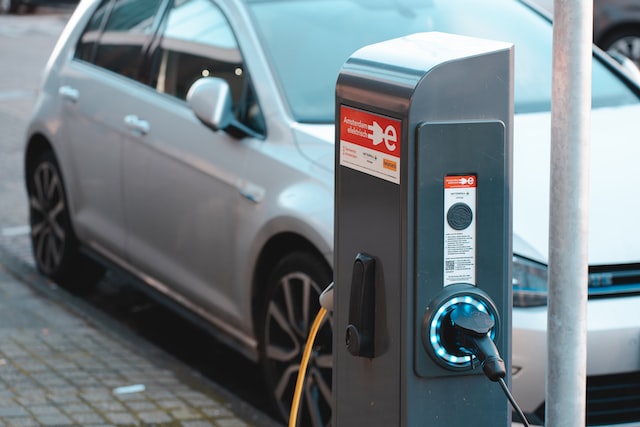
It is an ambitious target — 30% of all cars to be electric by 2030.
There is broad agreement that achieving it will require a significant scaling up of charging infrastructure, reports RTE.
Central to that is finding an answer for those who want to make the switch to electric but have no private driveway — making affordable home charging a genuine obstacle.
This challenge is being actively worked on by authorities in Ireland and elsewhere, all keen to prevent charging cables being trailed across public footpaths and creating trip hazards and legal liabilities, reports RTE.
In the London borough of Bromley, a cross-footway scheme has been piloted that may offer one solution.
Officials there have been cutting shallow channels into the ground running across public footpaths, reports RTE.
The charging cable runs from the home, is fitted into the gully, covered with PVC rubber, and connected to the car.
It is lifted out when not in use, with the design intended to eliminate the trip hazard, reports RTE.
John Trendler, who lives in a terraced house in Bromley, had a channel fitted a couple of years ago and says he has no regrets, pointing to the savings from paying the lower domestic rate rather than using public charging points.
“We’ve got a public path here, and we had no way of charging it, so it was actually a case of going to local charging units which is quite expensive … it’s been an absolute saving in terms of cost and flexibility and easy way of doing it.
“I think local public charges are getting on for 90p a kilowatt, whereas home here you do an overnight rate of 7p a kilowatt,” reports RTE.
Mr Trendler said interest from neighbours has been strong.
“I’ve had a few people knock on the door and ask where I got it from because they’re interested in EVs themselves and have a similar problem where they can’t charge them without putting cables across public footpaths,” reports RTE.
Bromley Council has declared the scheme a success, with around 50 channels installed at a cost of £1,000 per resident.

Conservative Councillor Simon Fawthrop, who oversees transport and the environment at the council, outlined the dual rationale behind the initiative, reports RTE.
“First of all, there are people that want electric vehicles, and if they want them, they deserve to be able to have them, but not everybody has the facilities to charge them at their own home, if they’re in a terraced house. So, it helps those people actually get access.
“Secondly, it makes sure that our streets aren’t cluttered, so people who are blind etc can actually walk smoothly.
“People who push chairs can travel the streets without having trip hazards all over the place, which sometimes happens,” Cllr Fawthorp says, reports RTE.
However, a review of the cross-footway scheme covering the London boroughs has flagged a number of concerns.
It highlighted a lack of detailed national standards for design, installation and upkeep, which is preventing authorities from adopting consistent policies, reports RTE.
The review also called for clearer guidance on managing electrical risks, planning requirements and the impact on street infrastructure.
It further noted the scheme is not appropriate in all settings — high-footfall areas are considered unsuitable — and that it risks creating friction between neighbours over parking spaces, reports RTE.
Tom Muckian, who lives in a terraced house in Dundalk, Co Louth, is weighing up switching to a plug-in vehicle for financial reasons.
“Everybody’s aware of what’s happening in the Middle East at the moment, and the impact on fuel prices, and the way that they’ve shot up in the last month or two months. So there’s that consideration,” reports RTE.
He is, however, held back by his circumstances.
“The difficulty we have is we’re on a terraced street, with very little in the way of front garden space, and the difficulty would be being able to charge it regularly and conveniently and easily,” reports RTE.
Mr Muckian is calling for “greater urgency” from the authorities in addressing the situation for people like him.
In a statement, the Department of Transport acknowledged the difficulties facing those without off-street parking and said it was committed to identifying a solution, with cross-departmental work under way and a framework due to be published later this year, reports RTE.
The department added that a pilot project involving public chargers is already in operation at a number of locations.
Tell us your thoughts in the Facebook post and share this with your friends.

